Clonal hematopoiesis (CH) is characterized by the expansion of genetically related blood cell populations derived from mutated hematopoietic stem cells. When these mutations involve genes associated with myeloid cancers and reach a variant allele fraction (VAF) of at least 2% without causing cytopenias, the condition is defined as clonal hematopoiesis of indeterminate potential (CHIP) (weeks2023causes?). This commentary summarizes the editorial by Weeks and Ebert (2025) which discusses research by Pich et al. on tumor-infiltrating clonal hematopoiesis (TI-CH) and its role in driving solid tumor progression.
4.2 Key Concepts and Definitions
key_concepts <-tribble(~Concept, ~Definition,"Clonal Hematopoiesis (CH)", "Expansion of a genetically related population of hematopoietic stem and progenitor cells that disproportionately contribute to blood-cell production","Clonal Hematopoiesis of Indeterminate Potential (CHIP)", "Defined by mutations in genetic drivers of myeloid cancers, a variant allele fraction of 2% or more, and the absence of cytopenias","Tumor-Infiltrating Clonal Hematopoiesis (TI-CH)", "Presence of CHIP mutations within tumors at a variant allele frequency (VAF) of 2% or more in at least one tumor region")key_concepts %>%kbl(caption ="Key Concepts in Clonal Hematopoiesis Research") %>%kable_styling(bootstrap_options =c("striped", "hover"), full_width =FALSE)
Key Concepts in Clonal Hematopoiesis Research
Concept
Definition
Clonal Hematopoiesis (CH)
Expansion of a genetically related population of hematopoietic stem and progenitor cells that disproportionately contribute to blood-cell production
Clonal Hematopoiesis of Indeterminate Potential (CHIP)
Defined by mutations in genetic drivers of myeloid cancers, a variant allele fraction of 2% or more, and the absence of cytopenias
Tumor-Infiltrating Clonal Hematopoiesis (TI-CH)
Presence of CHIP mutations within tumors at a variant allele frequency (VAF) of 2% or more in at least one tumor region
4.3 CHIP and Disease Associations
CHIP has been previously associated with several conditions:
4.4 Major Findings from Pich et al. (2025) (n.d.-a)
Pich et al. conducted a comprehensive analysis of tumor-infiltrating clonal hematopoiesis (TI-CH) across multiple cancer cohorts:
findings <-tribble(~Study_Cohort, ~Sample_Size, ~Key_Finding,"TRACERx", "421 patients with early-stage lung cancer", "42% of patients with CHIP had TI-CH","MSK-IMPACT", "49,351 patients across 75 cancer types", "26% of patients with CHIP had TI-CH","TRACERx Risk Analysis", "421 patients", "Patients with TI-CH had ~2× higher risk of death or recurrence","MSK-IMPACT Risk Analysis", "49,351 patients", "TI-CH was associated with increased risk of death from any cause","Cancer Type Analysis", "MSK-IMPACT cohort", "TI-CH enriched in non-small-cell lung cancer, head and neck cancer, pancreatic cancer, and mesothelioma")findings %>%kbl(caption ="Major Findings Related to TI-CH from Pich et al. (2025)") %>%kable_styling(bootstrap_options =c("striped", "hover"), full_width =FALSE)
Major Findings Related to TI-CH from Pich et al. (2025)
Study_Cohort
Sample_Size
Key_Finding
TRACERx
421 patients with early-stage lung cancer
42% of patients with CHIP had TI-CH
MSK-IMPACT
49,351 patients across 75 cancer types
26% of patients with CHIP had TI-CH
TRACERx Risk Analysis
421 patients
Patients with TI-CH had ~2× higher risk of death or recurrence
MSK-IMPACT Risk Analysis
49,351 patients
TI-CH was associated with increased risk of death from any cause
Cancer Type Analysis
MSK-IMPACT cohort
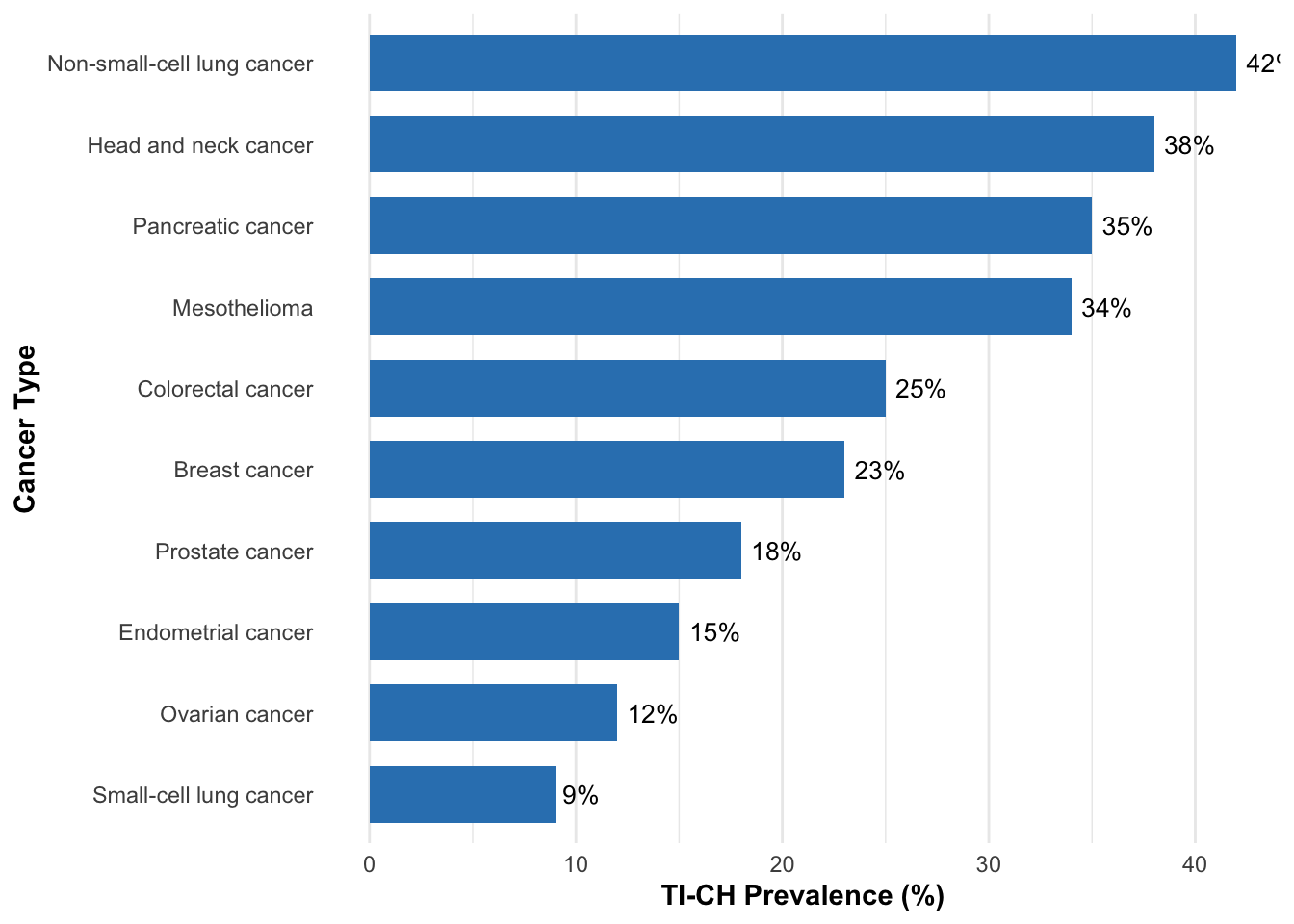
TI-CH enriched in non-small-cell lung cancer, head and neck cancer, pancreatic cancer, and mesothelioma
4.5 Genetic and Molecular Insights
genetic_insights <-tribble(~Finding, ~Description,"TET2 Mutations", "TET2-mutant CHIP was the strongest genetic predictor of TI-CH","Monocyte Migration", "TET2-mutant monocytes preferentially migrate toward lung cancer cells","Differentiation Pattern", "TET2-mutant myeloid cells differentiate into CD11+ macrophages in the tumor microenvironment","Organoid Growth", "Enhanced organoid growth in cocultures with TET2-mutant myeloid cells","Inflammatory Response", "TET2 mutations are associated with elevated levels of interleukin-1β")genetic_insights %>%kbl(caption ="Genetic and Molecular Insights on TI-CH") %>%kable_styling(bootstrap_options =c("striped", "hover"), full_width =FALSE)
Genetic and Molecular Insights on TI-CH
Finding
Description
TET2 Mutations
TET2-mutant CHIP was the strongest genetic predictor of TI-CH
Monocyte Migration
TET2-mutant monocytes preferentially migrate toward lung cancer cells
Differentiation Pattern
TET2-mutant myeloid cells differentiate into CD11+ macrophages in the tumor microenvironment
Organoid Growth
Enhanced organoid growth in cocultures with TET2-mutant myeloid cells
Inflammatory Response
TET2 mutations are associated with elevated levels of interleukin-1β
Hypothetical representation of TI-CH prevalence by cancer type based on described enrichment patterns
4.8 Clinical Implications
implications <-tribble(~Implication, ~Description,"Prognostic Value", "TI-CH serves as a prognostic indicator for solid tumor progression and patient survival","Therapeutic Target", "TI-CH, rather than circulating CHIP, may be a potential target for interventions that regulate tumor progression","Antiinflammatory Therapy", "Future trials could target specific TI-CH genotypes most likely to benefit from interleukin-1β inhibition","Cancer Prevention", "Potential for antiinflammatory therapies to prevent cancer initiation in solid-tumor precursors","Metastasis Prevention", "Possibility of preventing metastasis of localized cancers by targeting TI-CH")implications %>%kbl(caption ="Clinical Implications of TI-CH Research") %>%kable_styling(bootstrap_options =c("striped", "hover"), full_width =FALSE)
Clinical Implications of TI-CH Research
Implication
Description
Prognostic Value
TI-CH serves as a prognostic indicator for solid tumor progression and patient survival
Therapeutic Target
TI-CH, rather than circulating CHIP, may be a potential target for interventions that regulate tumor progression
Antiinflammatory Therapy
Future trials could target specific TI-CH genotypes most likely to benefit from interleukin-1β inhibition
Cancer Prevention
Potential for antiinflammatory therapies to prevent cancer initiation in solid-tumor precursors
Metastasis Prevention
Possibility of preventing metastasis of localized cancers by targeting TI-CH
4.9 Evidence from the CANTOS Study
The commentary discusses findings from the CANTOS (Canakinumab Antiinflammatory Thrombosis Outcome Study) trial that provide context for understanding the relationship between inflammation, CHIP, and cancer:
cantos_findings <-tribble(~Finding, ~Details,"Cardiovascular Risk Reduction", "Most dramatic reductions in cardiovascular disease risk among canakinumab-treated participants with TET2-mutant CHIP","Lung Cancer Incidence", "67% lower incidence of lung cancer after 3.7 years of follow-up in participants who received canakinumab versus placebo","Mechanism Hypothesis", "TET2 mutations are associated with elevated levels of interleukin-1β, which may link inflammation to cancer development")cantos_findings %>%kbl(caption ="Relevant Findings from the CANTOS Trial") %>%kable_styling(bootstrap_options =c("striped", "hover"), full_width =FALSE)
Relevant Findings from the CANTOS Trial
Finding
Details
Cardiovascular Risk Reduction
Most dramatic reductions in cardiovascular disease risk among canakinumab-treated participants with TET2-mutant CHIP
Lung Cancer Incidence
67% lower incidence of lung cancer after 3.7 years of follow-up in participants who received canakinumab versus placebo
Mechanism Hypothesis
TET2 mutations are associated with elevated levels of interleukin-1β, which may link inflammation to cancer development
4.10 Outstanding Questions
questions <-tribble(~Question, ~Context,"Why is TI-CH detected in some persons with CHIP and not in others?", "Mechanism","What explains the varied TI-CH detection in metastatic lesions?", "Metastasis","How can tumor homing of CHIP cells be therapeutically manipulated?", "Treatment","What is the connection between proinflammatory cytokine activity and protumorigenic capacity?", "Biology","What are the biologic factors underlying genotype specificity?", "Molecular Mechanism")questions %>%kbl(caption ="Unanswered Questions in TI-CH Research") %>%kable_styling(bootstrap_options =c("striped", "hover"), full_width =FALSE)
Unanswered Questions in TI-CH Research
Question
Context
Why is TI-CH detected in some persons with CHIP and not in others?
Mechanism
What explains the varied TI-CH detection in metastatic lesions?
Metastasis
How can tumor homing of CHIP cells be therapeutically manipulated?
Treatment
What is the connection between proinflammatory cytokine activity and protumorigenic capacity?
Biology
What are the biologic factors underlying genotype specificity?
Molecular Mechanism
4.11 Conclusion
The editorial by Weeks and Ebert(n.d.-b) highlights the significant role of tumor-infiltrating clonal hematopoiesis (TI-CH) in solid tumor progression. The research by Pich et al. robustly demonstrates the prognostic significance of TI-CH and provides insights into the complex interplay between age-related expansion of clonal hematopoiesis and inflammatory cells within the solid-tumor microenvironment.
TI-CH, rather than circulating CHIP, emerges as a potential target for interventions that could regulate tumor progression and metastasis in solid cancers. The genotype-specific effects, particularly the strong association with TET2 mutations, suggest that targeted approaches based on specific mutations could be effective therapeutic strategies.
Future research should focus on understanding the mechanisms driving TI-CH development, explaining its variability across metastatic lesions, and developing therapeutic approaches to manipulate tumor homing of CHIP cells to prevent cancer-related deaths.