17 Economic Analysis of CHIP Management Approaches
Universal vs. Precision Medicine: The Fox View
17.1 Introduction
- Clonal Hematopoiesis of Indeterminate Potential (CHIP) is a pre-cancerous condition
- Prevalence increases dramatically with age
<1% in under 40
10-15% in over 65
20% in over 90
- Major debate: Universal screening vs. Precision medicine

CHIP is the presence of somatic mutations in hematopoietic stem cells that leads to clonal expansion but without other diagnostic criteria for a hematological malignancy.
17.2 The Fox vs. Hedgehog Principle
“The fox knows many things, but the hedgehog knows one big thing.”
– Archilochus (Greek poet)
17.2.1 Hedgehog View (Universal)
- One big idea: All CHIP is concerning
- Screen everyone over certain age
- Treat all patients with CHIP
- Simple implementation
17.2.2 Fox View (Precision)
- Many factors determine risk
- Gene type (TP53, SF3B1 vs. DNMT3A)
- Clone size (VAF >20%)
- Growth rate
- Presence of cytopenia
17.3 Universal CHIP Screening Cost Analysis
17.3.1 Target Population and Screening Costs
| Category | Low Estimate | High Estimate | Notes |
|---|---|---|---|
| US Adults Age 65+ | 54M | 54M | 2023 demographic data |
| Cost per NGS Test | $200 | $600 | Targeted panel vs. WGS |
| Initial Screening Cost | $10.8B | $32.4B | One-time population screening |
| CHIP Prevalence | 10% | 15% | Increases with age |
| Number of CHIP Cases | 5.4M | 8.1M | Identified through screening |
Source: Prevalence data from Vlasschaert C et al. Blood 2023; NGS costs from current market analysis
17.4 Patient Care Costs
17.4.1 Annual Costs for Identified CHIP Patients
| Category | Low Estimate | High Estimate | Notes |
|---|---|---|---|
| Monitoring Cost/Patient | $1,500 | $3,000 | CBC, molecular testing, evaluation |
| Treatment Cost/Patient | $20,000 | $60,000 | Based on similar therapies |
| Total Patient Care | $116.1B | $510.3B | For all 5.4M-8.1M patients |
Most screened patients (>90%) would never develop malignancy, resulting in substantial overtreatment
17.5 Total Economic Impact
17.5.1 Comprehensive Annual Cost Estimate
| Category | Low Estimate | High Estimate |
|---|---|---|
| Patient Care Costs | $116.1B | $510.3B |
| Implementation & Infrastructure | $4.0B | $10.0B |
| TOTAL ANNUAL COST | $120.1B | $520.3B |
| % of US Healthcare Budget | ~3% | ~13% |
For context: All current cancer care in the US costs approximately $200 billion annually
17.6 Key Growth Factors in CHIP Progression
Attaching package: 'dplyr'The following objects are masked from 'package:stats':
filter, lagThe following objects are masked from 'package:base':
intersect, setdiff, setequal, union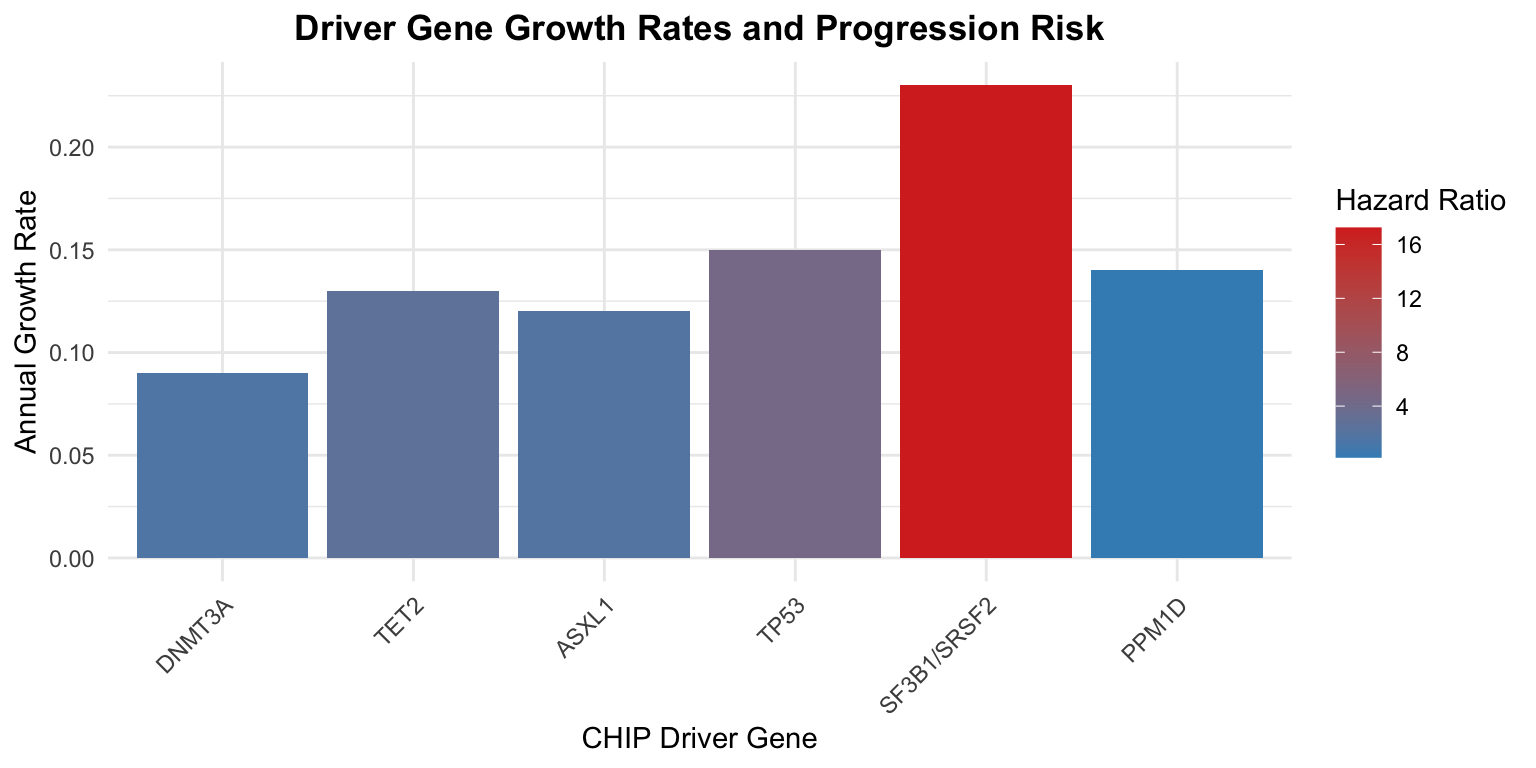
Data adapted from Kishtagari et al. Blood Cancer Journal 2024 and Mack T et al. Haematologica 2024
17.7 Precision vs. Universal Approach: Cost Comparison
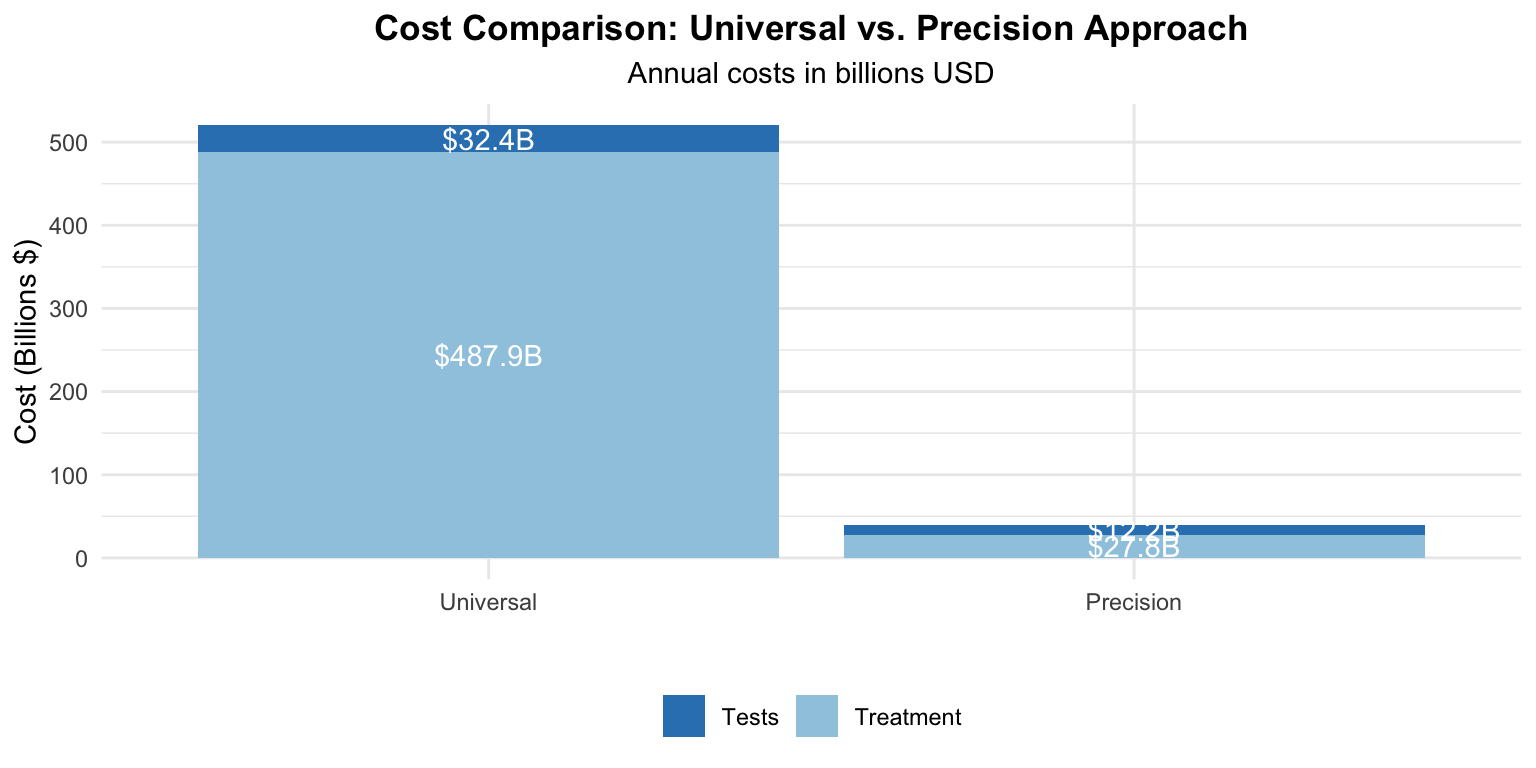
The precision medicine approach costs approximately $40 billion annually (92% less than universal approach) while focusing resources on patients with highest progression risk
17.8 Precision Approach Economics
17.8.1 Risk-Stratified CHIP Management
| Risk Category | Prevalence | Testing Strategy | Monitoring | Intervention | Annual Cost |
|---|---|---|---|---|---|
| High | 0.5% | Full genomic + cytopenia | Every 3 mo | Clinical trials | $2.5B |
| Moderate | 2.5% | Targeted panel + CBC | Every 6 mo | Observational cohort | $4.3B |
| Low | 7-12% | Targeted panel | Annual CBC | Observation only | $3.0B |
| Infrastructure & Research | - | - | - | - | $30B |
| TOTAL | 10-15% | - | - | - | $39.8B |
The precision approach directs resources where they have the highest impact, with approximately 90% of spending focused on high and moderate risk patients
17.9 Key Evidence Supporting Precision Approach
17.9.1 Scientific and Economic Justification
- Cytopenia is required for progression
- CHIP without cytopenia rarely progresses to malignancy
- Monitoring for cytopenia is cost-effective surrogate endpoint
- Driver gene determines risk
- SF3B1/SRSF2 mutations have 17× higher risk than DNMT3A
- Treatment matching mutation type shows greater efficacy
- Clone size and growth rate matter
- VAF >20% has 27× higher risk than VAF <5%
- Faster growth rate strongly correlates with progression
Based on Weeks L, et al. NEJM Evidence 2023 and Kishtagari A, et al. Blood Cancer Journal 2024
17.10 Fox vs. Hedgehog: The Economic Reality
17.10.1 Hedgehog (Universal)
- $520 billion annual cost
- One-size-fits-all approach
- Significant overtreatment
- Unsustainable burden on healthcare systems
- Diverts resources from other health priorities
17.10.2 Fox (Precision)
- $40 billion annual cost
- Risk-stratified approach
- Resource allocation by risk level
- Economically sustainable model
- Prioritizes scientific evidence

17.11 Conclusions
17.11.1 Economic Argument for Precision Medicine in CHIP
Dr. Kishtagari’s thesis that “chemoprevention and treatment of CHIP will never be implemented widely or universally” is strongly supported by economic analysis.
- Universal screening and treatment would cost $120-520 billion annually
- Represents 3-13% of entire US healthcare expenditure
- Precision approach reduces costs by 92% while maintaining clinical benefit
- Risk stratification is essential for sustainable implementation
- Cytopenia monitoring provides cost-effective surrogate endpoint
17.12 Acknowledgments
Vanderbilt University Medical Center - Dr. Ashwin Kishtagari - Bick Lab - Hematology and SCT Faculty
Data Sources - Vlasschaert C et al. Blood 2023 - Weeks L, et al. NEJM Evidence 2023 - Kishtagari A, et al. Blood Cancer Journal 2024 - Mack T et al. Haematologica 2024