Clonal Hematopoiesis in Sickle Cell Disease
Clinical implications in the era of curative therapy
Division of Hematology/Oncology, Vanderbilt University Medical Center
2026-08-16
Why this matters now
Curative cellular therapies for SCD are expanding, and rare but fatal myeloid malignancies have followed both transplant and gene therapy. Clonal hematopoiesis is the biological thread.
- Myeloid neoplasia is more common in SCD, and the cases look high-risk
- CH is a recognized precursor of MDS and AML
- In SCD, CH begins in childhood and favors TP53 and DNA-damage genotypes
- Curative therapy acts as a selective bottleneck that expands these clones
The clinical problem
Myeloid malignancy risk is elevated in SCD, but absolute risk stays low
Two population studies anchor the epidemiology:
- California Cancer Registry: 72% higher risk of hematologic malignancy, driven by a 3.6-fold increase in AML (Brunson et al. 2017)
- English national linkage of 7512 patients: 11-fold increased AML risk (Seminog et al. 2016)
In both, fewer than 10 AML cases occurred during observation. The relative risk is striking; the absolute risk is not.
SCD is increasingly described as a condition of accelerated biological aging, with adults now reaching median survivals near 58 to 67 years in resourced settings (Weeks 2026). Longer survival brings age-related malignancy into view, and the leukemia signal in California began as early as age 15.
Brunson 2017 · Seminog 2016 · Weeks 2026
The reported cases share a high-risk phenotype
Across published MDS, AML, and CMML in SCD, several features recur (Weeks 2026):
- Onset at younger ages than expected, including pediatric AML
- Recurrent TP53 mutations and complex karyotypes
- High-risk, treatment-refractory disease biology
- Clustering of cases after allogeneic transplant, often in the setting of graft failure
Clonal hematopoiesis as the link
What we mean by CH, and why the detection threshold matters
CH is the expansion of a hematopoietic clone carrying a myeloid driver mutation. WHO recognizes two subtypes: CHIP (VAF ≥ 2%, no cytopenia) and CCUS (with unexplained cytopenia).
The 2% threshold reflects older sequencing error rates, not biology (Weeks 2026). Error-corrected assays reach VAF ~0.03%. SCD clones are small, so an insensitive assay misses them.
This one methodological point explains most of the apparent disagreement in the SCD literature.
Weeks 2026
Three hypotheses for why SCD drives myeloid clones
- DNA damage. Oxidative stress and telomere attrition from high cell turnover, plus therapy exposures, select for clones with mutations in DNA-damage-response genes
- Accelerated turnover. High-output erythropoiesis speeds hematopoietic aging and predisposes to age-related myeloid neoplasia
- Germline predisposition. Co-inherited alleles may independently raise leukemogenic risk
Resolving the prevalence controversy
Opposing results were largely a question of assay sensitivity
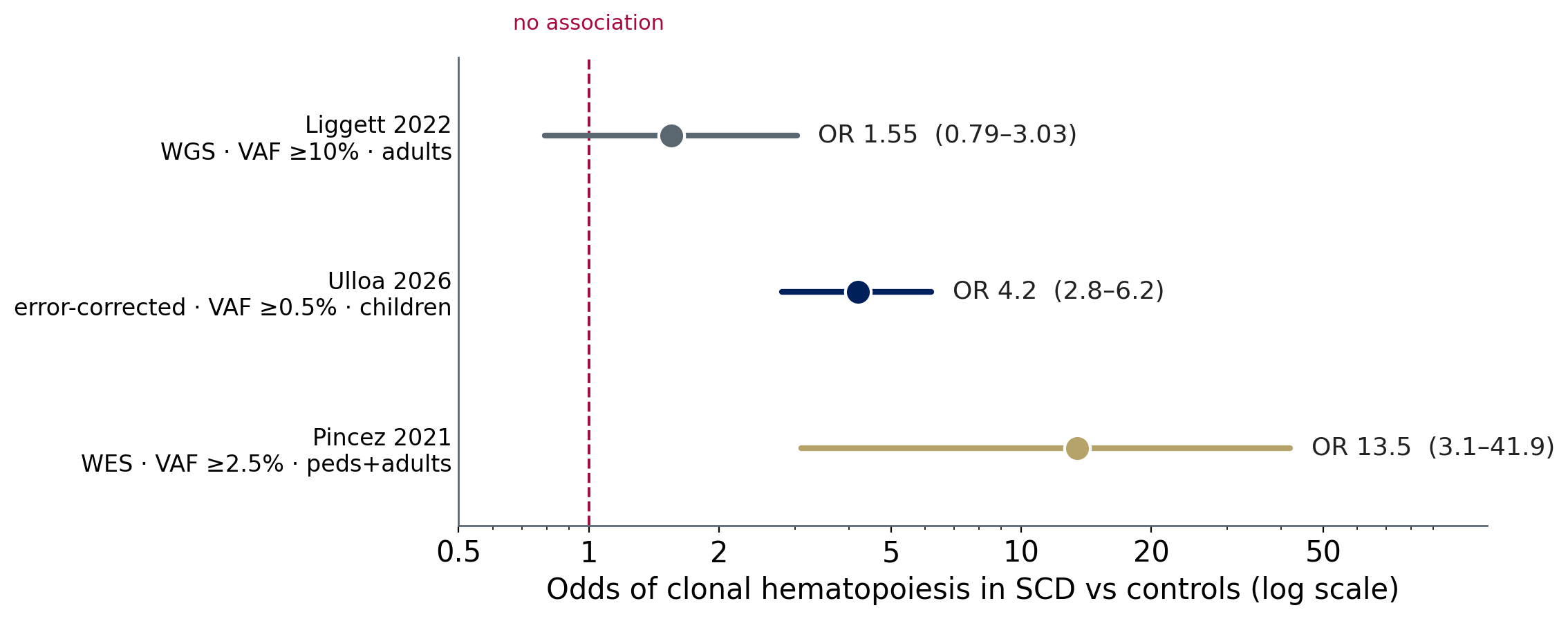
Odds of clonal hematopoiesis in SCD versus controls across three studies. Detection threshold and study population both shape the estimate; the through-line is that CH in SCD is dominated by small, low-VAF clones that only sensitive assays capture.
Pincez 2021 · Liggett 2022 · Ulloa 2026
Children with sickle cell disease already carry more CH
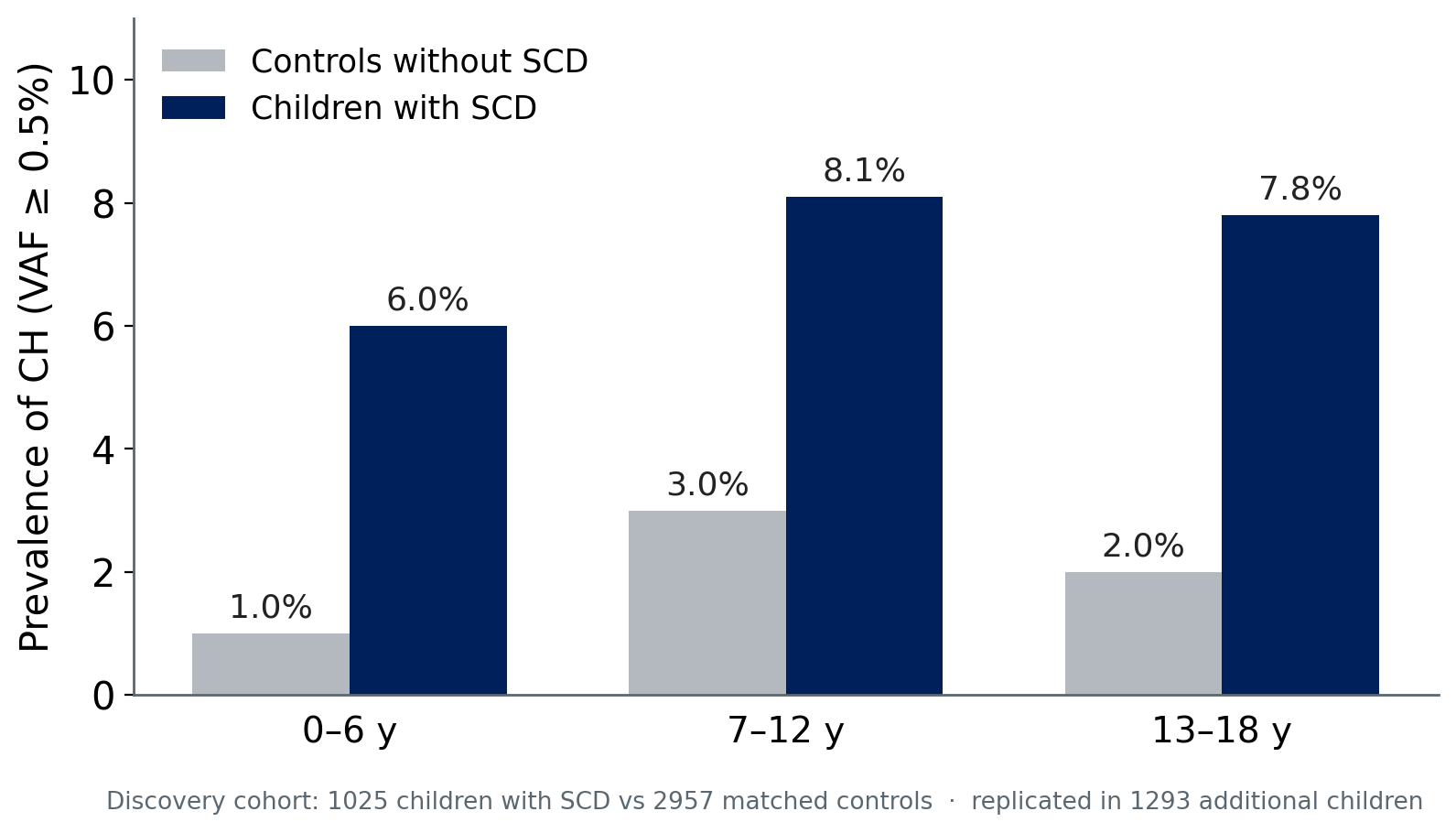
Prevalence of clonal hematopoiesis by age in children with SCD versus matched controls, measured with error-corrected sequencing at VAF ≥ 0.5%.
Error-corrected sequencing found CH in 7.2% of children with SCD versus 1.9% of controls, an adjusted OR 4.2 (95% CI 2.8–6.2, P = 7.4 × 10⁻¹³), replicated in a second cohort of 1293 children (Ulloa et al. 2026).
Ulloa 2026
The clones do not behave like age-related CH
- Hydroxyurea was not associated with CH in children (OR 0.76, 95% CI 0.38–1.5, P = .44) (Ulloa et al. 2026)
- SCD clones carry a mutational signature of defective homologous-recombination repair, pointing back to DNA-damage mechanisms rather than simple aging
- Clonal growth rates differ significantly from age-related CH, so adult CHIP risk models cannot be assumed to transfer
Preliminary VUMC data
In an adult SCD cohort, the prevalence gap versus non-SCD controls attenuates (OR ≈ 0.9, not significant), consistent with survivorship and with a childhood-onset, early-selection model. Unpublished; interpret with caution.
Curative therapy as a selective bottleneck
Cellular therapy selects pre-existing high-risk clones
Transplant. In adults with SCD who developed myeloid malignancy after allo-HCT, the driving TP53 mutations were already present in baseline blood at VAF < 1% (Ghannam et al. 2020).
Gene therapy. Two MDS/AML cases followed autologous gene therapy, neither from insertional mutagenesis (Goyal et al. 2022; Hsieh et al. 2020). Whole-genome tracking shows the procedure selects for stem cells already carrying CH (Weeks 2026).
Ghannam 2020 · Goyal 2022 · Hsieh 2020 · Weeks 2026
Donor and recipient CH after nonmyeloablative transplant
Error-corrected sequencing of 98 SCD recipients and 72 non-SCD donors (Weeks et al. 2026):
- Baseline CH prevalence was similar, but SCD recipients had 3.8-fold higher odds of DNA-damage-response CH (TP53, PPM1D, ATM, CHEK2)
- After transplant, CH rose, driven by DNMT3A/TET2 and TP53
- Post-transplant clones came from three sources: newly emergent variants, engrafted donor CH (all DNMT3A/TET2), and persistent recipient DNA-damage-response CH
- Malignancy was rare but included 3 fatal TP53-mutant MDS/AML
Weeks 2026 (Blood)
What this means at the bedside
Counseling and risk stratification
- Population screening for CH in SCD is not justified: low absolute risk, no proven mitigation (Weeks 2026)
- Risk tools such as the CHRS are unvalidated in SCD or after cellular therapy and likely underestimate risk here (Weeks et al. 2023)
- Counseling matters most before allo-HCT or gene therapy; with TP53-mutant CH, favor complete donor chimerism and weigh caution before autologous gene therapy
- Early-interception CCUS trials largely exclude SCD, yet these patients may benefit most
Discussion
An incidental TP53 mutation at VAF 0.4% turns up before gene therapy. Does it change your recommendation, monitoring, or consent conversation?
The one sentence to carry out of here
In sickle cell disease, clonal hematopoiesis begins early, favors TP53 and DNA-damage genotypes, and is amplified by curative therapy, so it belongs in how we counsel and risk-stratify these patients now.
What we still need
- High-sensitivity, error-corrected sequencing as the standard for CH research in SCD
- Serial sampling to capture clonal dynamics, not single-timepoint snapshots
- SCD-specific risk algorithms built from linked clinical and genomic data
- Multi-institutional collaboration to reach the numbers these questions require
References
Clonal Hematopoiesis in Sickle Cell Disease · Ashwin Kishtagari, MBBS, MSCI · VUMC