(0.0, 112.0)Acute Promyelocytic Leukemia for Fellows
Ashwin Kishtagari, MBBS, MSCI
Division of Hematology/Oncology, Vanderbilt University Medical Center
2026-08-18
Overview
What is APL?
Acute promyelocytic leukemia (APL) is a distinct subtype of acute myeloid leukemia — about 5–8% of AML.
- Defined by the translocation t(15;17)(q24;q21), creating the PML::RARA fusion gene
- Once rapidly fatal, it is now one of the most curable hematologic malignancies
- The turnaround came from targeting the fusion protein directly — not cytotoxic chemotherapy
A Medical Emergency
The coagulopathy
APL is a hematologic emergency — the danger is not the leukemia burden but the bleeding.
- A severe coagulopathy combining DIC and hyperfibrinolysis
- Hemorrhage (intracranial, pulmonary) is the leading cause of early death
- Early death remains the biggest threat to cure, especially in older patients
Warning
Catastrophic bleeding can occur in the first hours to days — before, and even during, effective treatment.
Act immediately
Suspected APL is treated before genetic confirmation returns.
- Start ATRA at the first suspicion — do not wait for PCR/cytogenetics
- Aggressive supportive care: transfuse platelets and replace fibrinogen / correct coagulopathy; hold invasive procedures
- Confirm the diagnosis in parallel
Pathophysiology
PML::RARA blocks differentiation
The fusion protein is the engine of the disease.
- RARA normally drives myeloid differentiation in response to retinoic acid
- PML::RARA acts as an aberrant receptor that represses differentiation
- Cells arrest at the promyelocyte stage and accumulate
How ATRA and ATO work
Two agents hit the same fusion protein at different ends — and act in synergy.
- ATRA (all-trans retinoic acid) binds the RARA moiety → releases the block and drives differentiation of the leukemic promyelocytes
- ATO (arsenic trioxide) binds the PML moiety → triggers degradation of PML::RARA and apoptosis
Together they clear the clone at both the differentiation and survival level — the basis of the modern chemo-free cure.
Diagnosis
Recognize, then confirm
Morphology / smear
- Hypergranular promyelocytes, bundles of Auer rods (faggot cells)
- Coagulopathy on labs (low fibrinogen, high D-dimer, thrombocytopenia)
Confirm PML::RARA
- RT-PCR, FISH, or karyotype for t(15;17)
- Rapid methods (FISH/PCR) support the presumptive diagnosis while treatment is already underway
Risk stratification (Sanz)
Risk is defined at presentation by white-cell and platelet counts (×10⁹/L):
| Risk group | WBC | Platelets |
|---|---|---|
| Low | ≤ 10 | > 40 |
| Intermediate | ≤ 10 | ≤ 40 |
| High | > 10 | any |
Low and intermediate risk are grouped as “non–high-risk” — the population where chemo-free ATRA + ATO is standard.
Treatment
The paradigm: ATRA + ATO
For non–high-risk APL, the standard of care is ATRA plus arsenic trioxide — no chemotherapy, no maintenance.
- ATRA 45 mg/m²/day (divided) + ATO 0.15 mg/kg/day IV
- Induction continues to hematologic remission; consolidation with the same agents
- Established by the APL0406 (Lo-Coco et al., NEJM 2013) trial
APL0406 — practice-changing
APL0406 compared ATRA + ATO against standard ATRA + chemotherapy (AIDA) in non–high-risk APL.
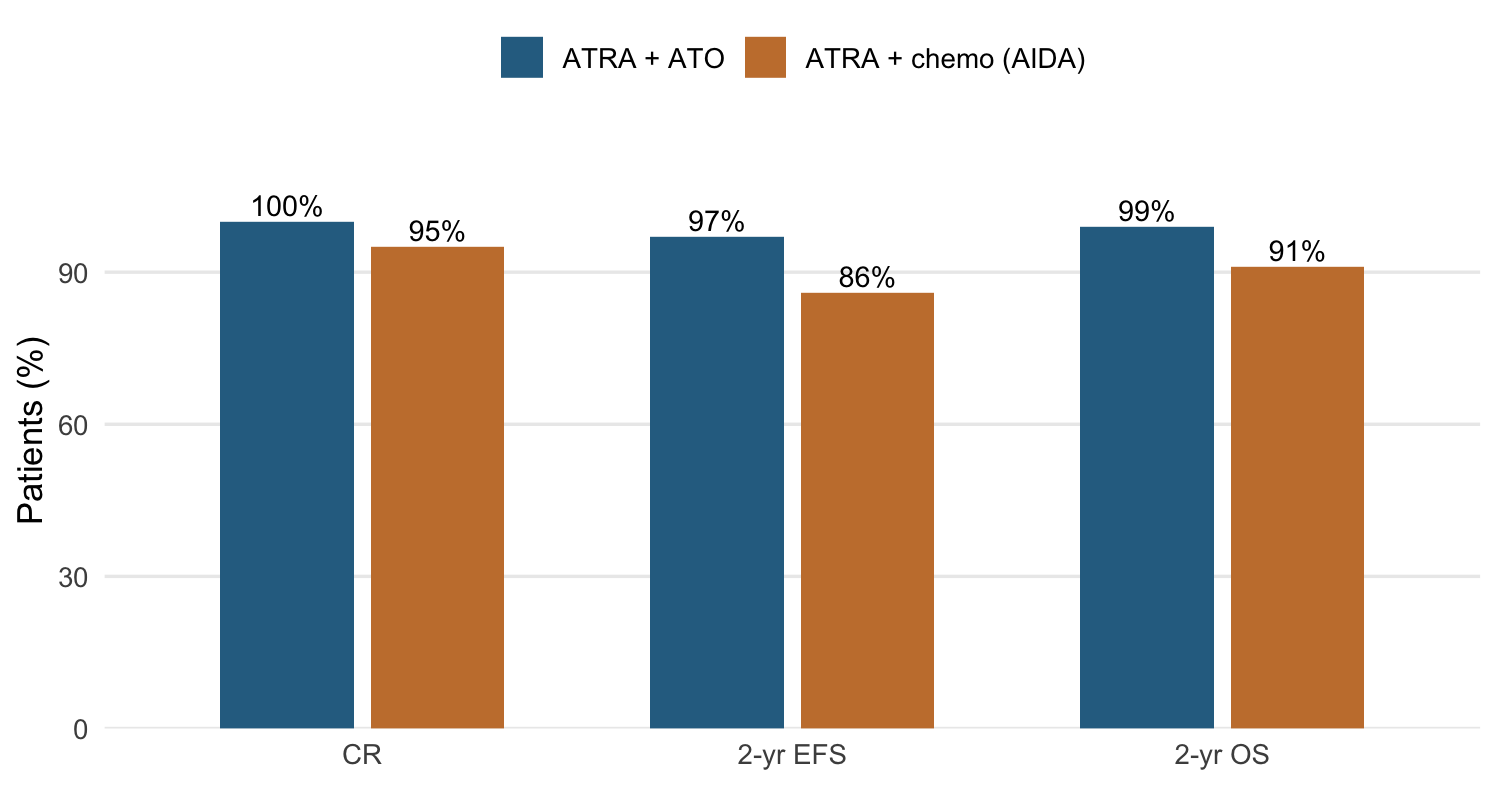
Figure 1
Note
ATRA + ATO was non-inferior and in fact superior. R / ggplot2.
Durable cure
The advantage held up long-term — with strikingly few relapses.
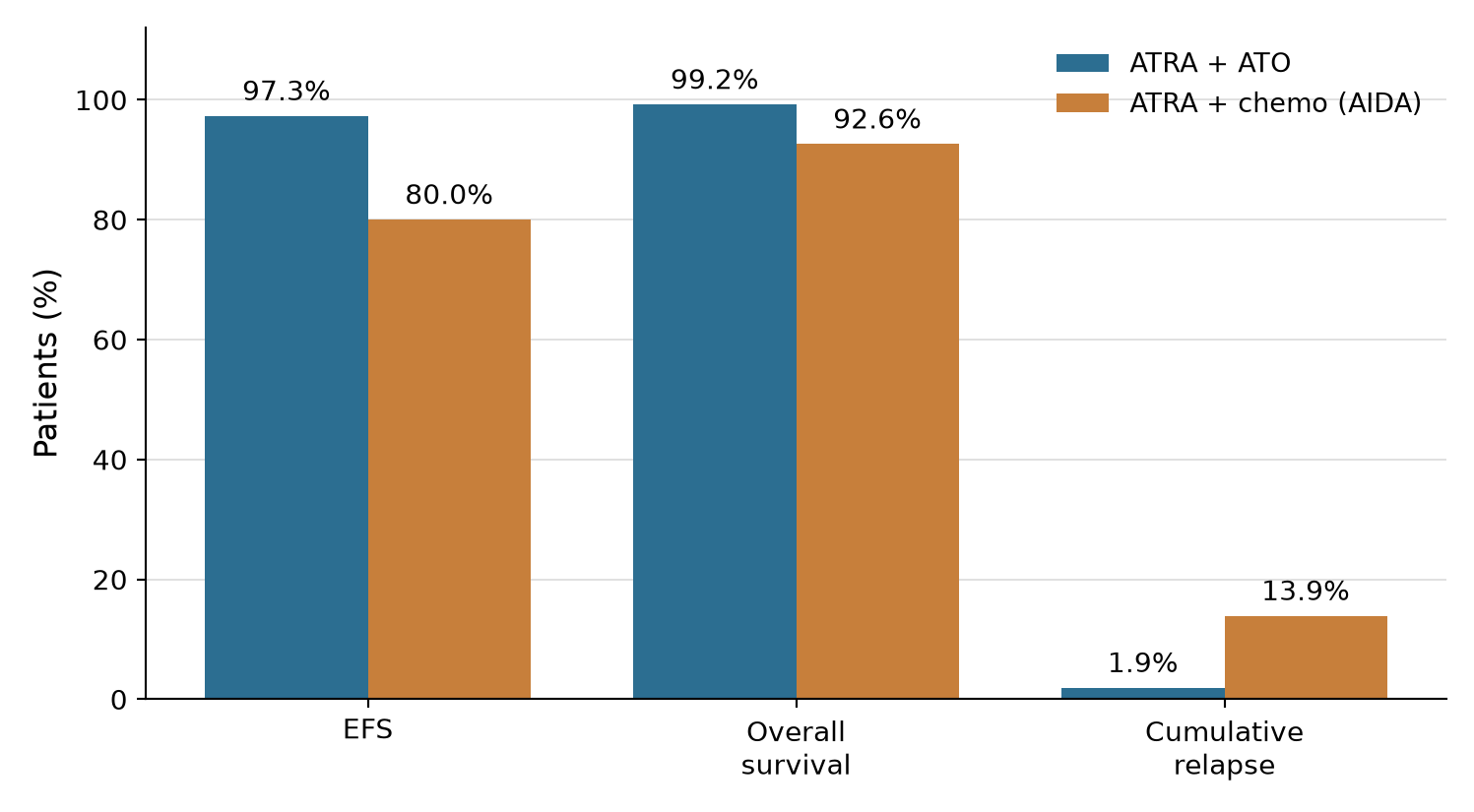
Figure 2
Note
APL0406 long-term (~50-month) outcomes. Cumulative relapse 1.9% vs 13.9%. Python / matplotlib.
High-risk disease
High-risk APL (WBC > 10) needs more than ATRA + ATO alone.
- Add chemotherapy — an anthracycline (e.g. idarubicin) — to the ATRA + ATO backbone
- Or add gemtuzumab ozogamicin (as used in the UK AML17 trial)
- Early cytoreduction and vigilant management of leukocytosis are important
Key complications
Differentiation syndrome (formerly retinoic acid syndrome)
- Fever, dyspnea, pulmonary infiltrates, edema, hypotension
- Prophylaxis (e.g. prednisone 0.5 mg/kg/day) and prompt corticosteroids for suspected cases
Arsenic toxicity
- QTc prolongation → monitor ECG and electrolytes at least twice weekly
- Leukocytosis, hepatotoxicity
Monitoring
Response and cure are tracked molecularly.
- MRD by PML::RARA RT-qPCR, typically after consolidation
- Molecular relapse can precede hematologic relapse — enabling pre-emptive therapy
Summary
Summary
- APL is AML with t(15;17) / PML::RARA — a bleeding emergency: start ATRA on suspicion and support aggressively
- ATRA and ATO target the fusion at both ends — the basis of a chemo-free cure
- Non–high-risk: ATRA + ATO is the standard (APL0406 — superior, durable, low relapse)
- High-risk: add anthracycline or gemtuzumab ozogamicin
- Watch for differentiation syndrome and QTc prolongation; monitor MRD by PCR
Warning
Educational overview built from well-established biology and published trial data (APL0406; ELN recommendations). Verify regimens, dosing, risk cut-offs, and monitoring against current authoritative guidelines and prescribing information before any teaching or clinical use.