Targeting Mutant Calreticulin in Essential Thrombocythemia
INCA033989 · EHA 2026 (PS1983, Mascarenhas et al.)
Ashwin Kishtagari, MBBS, MSCI
Division of Hematology/Oncology, Vanderbilt University Medical Center
2026-08-18
Background
The unmet need in CALR-mutant ET
Essential thrombocythemia (ET) features megakaryocyte hyperplasia and clustering, thrombocytosis, and a raised risk of thrombosis, hemorrhage, and transformation to myelofibrosis (MF).
- Calreticulin (CALR) exon 9 mutations occur in ~25–30% of ET
- mutant CALR (mutCALR) ET tends to present younger and carries a higher risk of MF transformation than JAK2 V617F disease
- Current cytoreductive drugs are broadly myelosuppressive, not mutant-targeted, and do little to lower mutCALR allele burden
INCA033989 — a mutCALR-targeted antibody
A novel, first-in-class, fully human, Fc-silenced IgG1 monoclonal antibody.
- Selectively binds mutCALR with high affinity when it is in complex with the thrombopoietin receptor (TPO-R / MPL)
- Blocks mutCALR-driven TPO-R dimerization and the resulting constitutive JAK-STAT signaling
- Aim: shut down oncogenic signaling and proliferation of the mutant clone
Note
This is an investigational agent — early-phase, not FDA-approved. The data here are from a phase 1, first-in-human program presented at EHA 2026.
Study Design
Phase 1, first-in-human
Two parallel studies: INCA033989-101 (NCT05936359; ex-US) and INCA033989-102 (NCT06034002; US).
- Multicenter, open-label, in patients with a CALR exon-9 mutation and high-risk ET or MF (monotherapy or combined with ruxolitinib)
- Administered IV every 2 weeks, dose range 24–2500 mg (alternative schedules also tested)
Key ET eligibility
- ET by 2022 WHO criteria, with mutCALR exon 9
- High risk (age ≥60, or prior thrombosis / major bleeding / extreme thrombocytosis)
- Resistance/intolerance to ≥1 prior cytoreductive therapy; platelets >450 G/L
- Concurrent hydroxyurea or anagrelide permitted
Endpoints
Primary
- Dose-limiting toxicities (DLTs)
- Treatment-emergent adverse events (TEAEs)
Secondary
- Response by ELN and clinically established criteria
- Symptom improvement (MPN-SAF TSS)
- Change in mutCALR allele burden (VAF)
- Pharmacokinetics
Patients (N = 114)
| Characteristic | Value |
|---|---|
| Median age, years (range) | 62 (23–89) |
| Female | 60.5% |
| Median time from diagnosis, years | 6.9 |
| CALR Type 1 / non–Type 1 | 43.9% / 56.1% |
| Median CALR VAF | 34% (10–75) |
| Median platelets, G/L | 913 (444–3152) |
| Prior hydroxycarbamide | 87.7% |
| Prior anagrelide / interferon | 31.6% / 30.7% |
| On aspirin at baseline | 60.5% |
Safety
Well tolerated
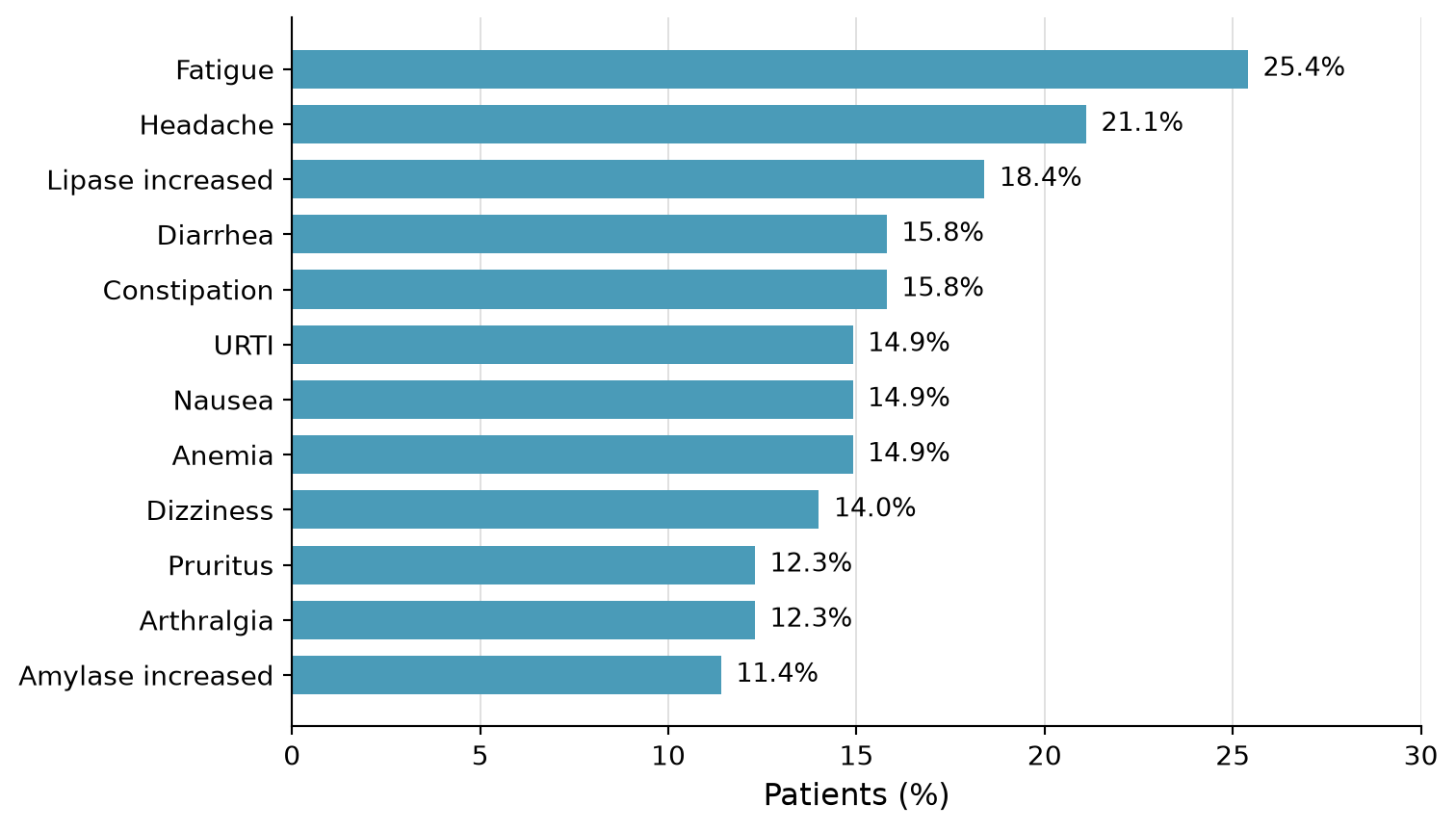
- 95% (108/114) remained on treatment; only 5% discontinued
- Median exposure 8.1 months (up to 27)
- No dose-limiting toxicities; no fatal TEAEs
- Grade ≥3 cytopenia TEAEs in 6% (7/114)
- No grade ≥3 thrombocytopenia — and most cytopenias occurred alongside concurrent hydroxyurea
- Lipase/amylase elevations were transient with no clinical sequelae
Most common TEAEs (≥10%)
Note
Overall TEAE rate 91%; treatment-related 61%; grade ≥3 19%; serious 4.4%.
Efficacy
Rapid, durable hematologic responses
Across all doses, response rates were high.
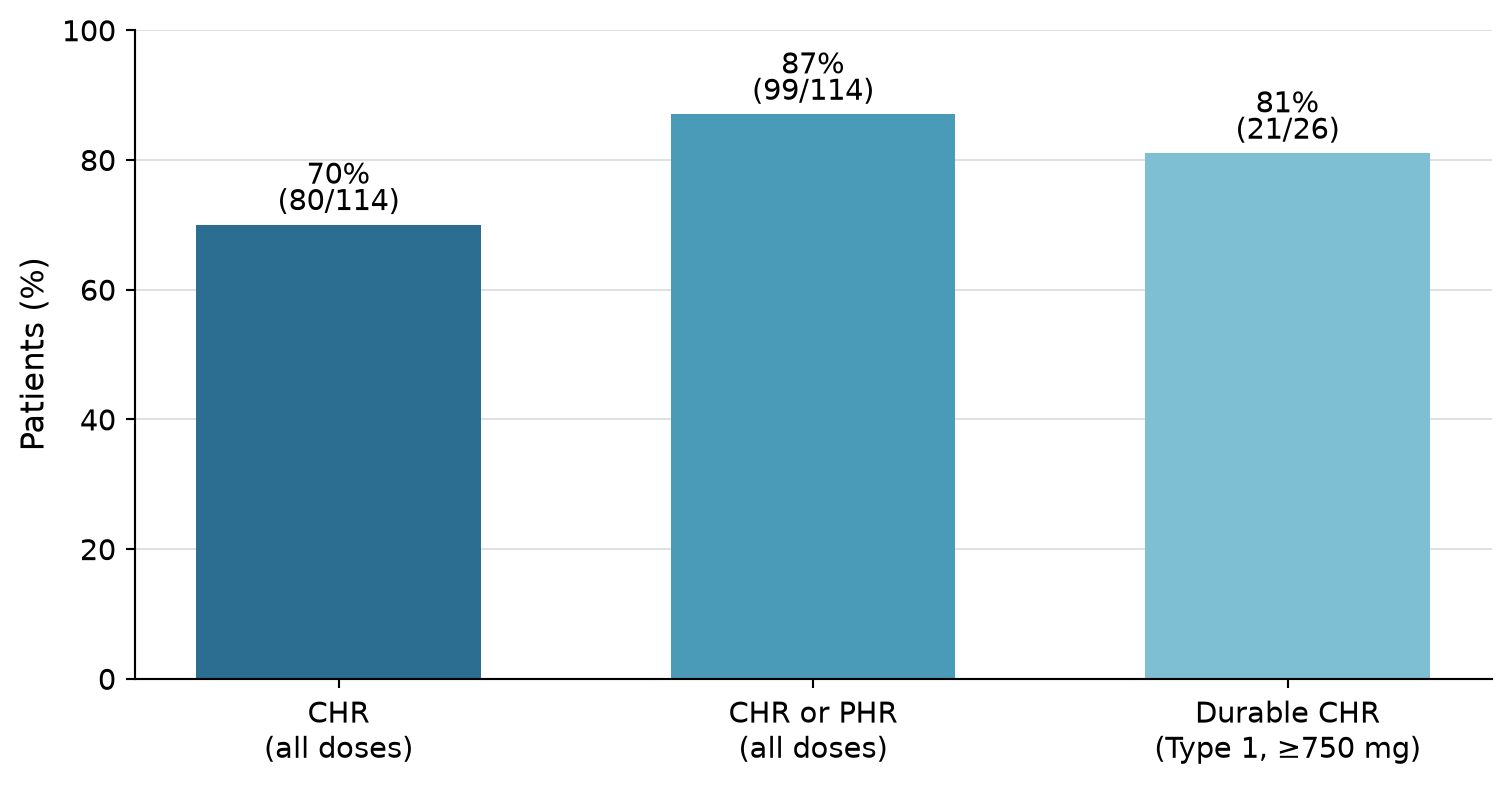
Response by mutCALR type and dose
- Median duration of CHR/PHR: 23 weeks (up to 107)
- Median time to durable CHR: 2.1 weeks — responses came on fast
- Type 1 mutCALR at ≥750 mg: durable CHR 81% (21/26)
- Non–Type 1 at 2500 mg: durable CHR/PHR 50% (3/6)
Dose titration brought patients started at lower doses into response — supporting an escalation strategy.
Molecular responses
The antibody lowered the malignant clone, not just the platelet count.
- A ≥25% reduction in mutCALR VAF correlated with durable CHR (nominal P < 0.0001, n = 103)
- Among patients with durable CHR and a post-baseline VAF reading, 73% (33/45) achieved a ≥25% VAF reduction
- Durable molecular responses occurred in both Type 1 and non–Type 1 disease
Mechanism of clonal response
The molecular response tracked to the mutant clone itself.
- Driven by loss of mutCALR myeloid cells and a rise in wild-type cells
- Bone marrow showed reduced total and mutCALR⁺ megakaryocytes from baseline to cycle 7
- Consistent with a disease-modifying, clone-directed effect rather than generic myelosuppression
Conclusions
Summary
- INCA033989 is a first-in-class antibody selectively targeting mutCALR in ET
- In pretreated, high-risk patients it was well tolerated — no DLTs, no grade ≥3 thrombocytopenia, 95% still on treatment
- Produced rapid, durable hematologic responses (CHR 70%; CHR/PHR 87%)
- Drove molecular responses that correlated with clinical benefit and reflected reduction of the mutant clone
What’s next
These data support a planned phase 3 program in ET:
EXCALIBUR-ET2 — NCT07623200
Warning
Early-phase, investigational data from a single EHA 2026 poster. Figures and framing are summarized for educational use and should be checked against the primary presentation; this agent is not approved and conclusions are preliminary pending phase 3.