---
title: "Menin Inhibitors in AML"
author: "Ashwin Kishtagari"
date: today
format:
  html:
    code-fold: true
    code-tools: true
    toc: true
    toc-depth: 3
    toc-location: right
    theme:
      light: flatly
      dark: darkly
    highlight-style: github
    page-layout: full
    smooth-scroll: true
    fig-responsive: true
execute:
  warning: false
  message: false
bibliography: references.bib
---

```{r setup}
#| echo: false
library(gt)
library(dplyr)
library(tidyr)
library(kableExtra)
library(tibble)
library(DT)
library(htmltools)
```

# Epidemiology & Biology {#sec-biology}

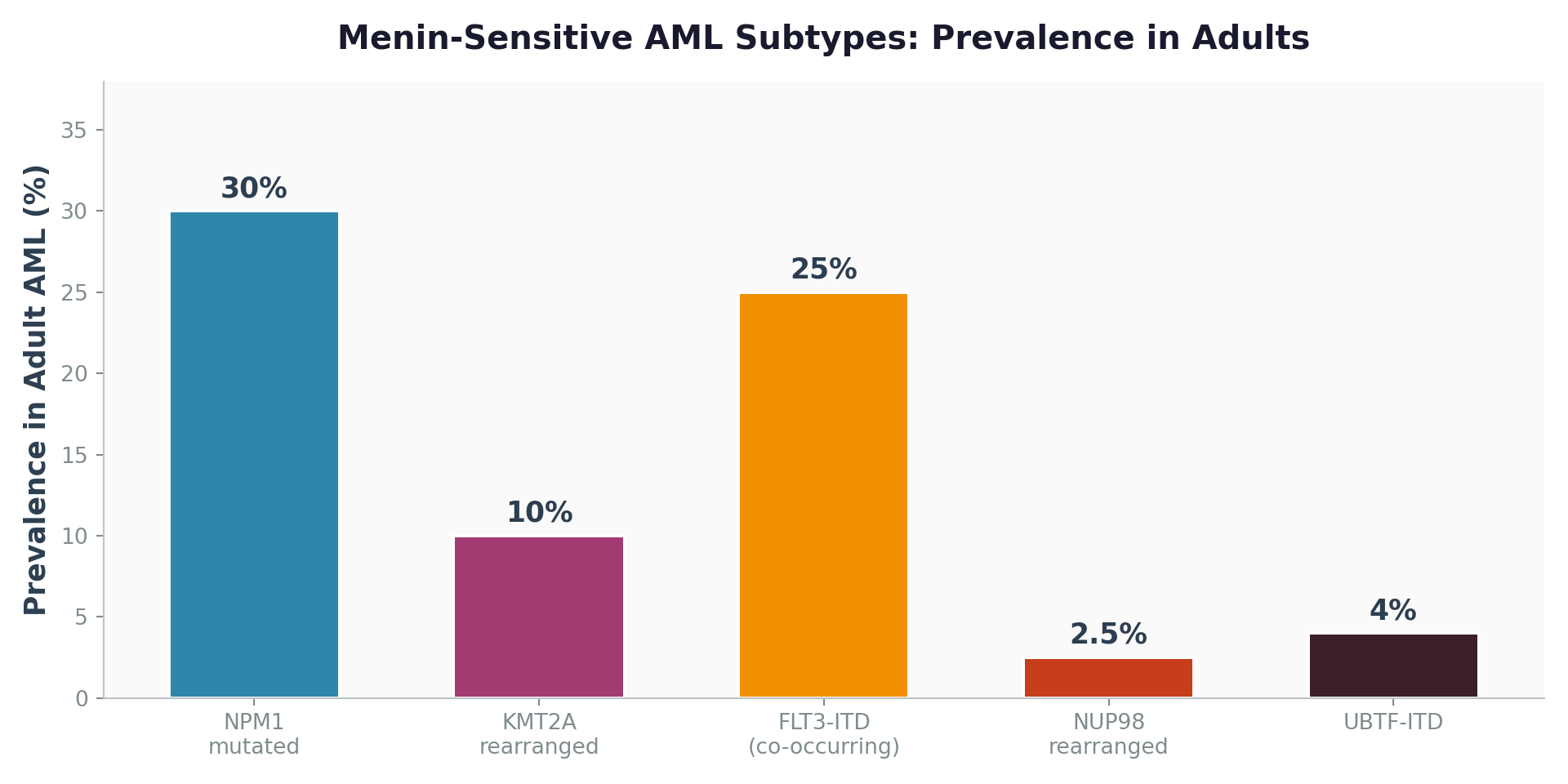
## Incidence of Menin-Dependent Leukemias

```{python}
#| echo: false
#| fig-width: 8
#| fig-height: 5

import matplotlib.pyplot as plt
import matplotlib
matplotlib.use('Agg')
import numpy as np

subtypes = ['NPM1\nmutated', 'KMT2A\nrearranged', 'FLT3-ITD\n(co-occurring)', 'NUP98\nrearranged', 'UBTF-ITD']
prevalence = [30, 10, 25, 2.5, 4]
colors = ['#2E86AB', '#A23B72', '#F18F01', '#C73E1D', '#3B1F2B']

fig, ax = plt.subplots(figsize=(10, 5))
bars = ax.bar(subtypes, prevalence, color=colors, width=0.6, edgecolor='white', linewidth=1.5)

for bar, val in zip(bars, prevalence):
    ax.text(bar.get_x() + bar.get_width()/2., bar.get_height() + 0.5,
            f'{val}%', ha='center', va='bottom', fontweight='bold', fontsize=13, color='#2c3e50')

ax.set_ylabel('Prevalence in Adult AML (%)', fontsize=13, fontweight='bold', color='#2c3e50')
ax.set_title('Menin-Sensitive AML Subtypes: Prevalence in Adults', fontsize=15, fontweight='bold', color='#1a1a2e', pad=15)
ax.set_ylim(0, 38)
ax.spines['top'].set_visible(False)
ax.spines['right'].set_visible(False)
ax.spines['left'].set_color('#bdc3c7')
ax.spines['bottom'].set_color('#bdc3c7')
ax.tick_params(colors='#7f8c8d')
ax.set_facecolor('#fafafa')
fig.patch.set_facecolor('white')
plt.tight_layout()
plt.savefig('prevalence_plot.png', dpi=150, bbox_inches='tight')
plt.show()
```

## Biology of Menin-MLL1 Interaction

- **KMT2A** has over 80 fusion partners; KMT2Ar AML involves chromosomal translocations leading to fusion oncoproteins that interact with **menin** to promote aberrant HOX gene expression and leukemogenesis.
- The most common KMT2Ar, **t(9;11)(p21.3;q23.3)/MLLT3::KMT2A**, is associated with an intermediate prognosis, while all other KMT2Ar AML falls under adverse risk disease.
- **Menin** is a nuclear scaffold protein encoded by the *MEN1* gene on chromosome 11q13.
- Menin-MLL1 interaction promotes an oncogenic transcriptional program driving leukemogenesis in HOX-mediated acute leukemias, including *KMT2A*-rearranged, *NPM1*-mutated, and *NUP98*-rearranged AML.

Currently recognized menin-sensitive leukemias include those with *KMT2A*-fusions, *KMT2A*-partial tandem duplications, *MN1*-fusions, *NPM1* mutations, *NUP98*-fusions, and *UBTF*-ITDs. All share expression of HOXA (and sometimes HOXB) cluster genes and MEIS1.

## Outcomes in KMT2Ar AML [@Issa2021]

In 172 adult patients with KMT2Ar AML compared to 522 age-matched diploid AML controls, KMT2Ar was associated with significantly worse outcomes regardless of translocation subtype. Median OS after first, second, and third lines of therapy was 10.8 months, 6 months, and 2.4 months compared with 2.1 years, 9.6 months, and 4.8 months in diploid AML controls (p \< 0.0001). Allo-HSCT in first remission was associated with improved OS (5-year: 52% vs 14%, p \< 0.0001).

## NPM1-Mutated R/R AML Outcomes [@Issa2023]

While NPM1m is associated with higher CR/CRi rates compared to NPM1 wild-type in R/R AML (first salvage: 56% vs 37%; second salvage: 33% vs 22%), it had no significant effect on RFS and OS following salvage therapy.

------------------------------------------------------------------------

# Menin Inhibitor Clinical Development Overview {#sec-overview}

```{r}
#| label: tbl-development-overview
#| tbl-cap: "Menin Inhibitors: Current Stages of Clinical Development"
#| echo: false

dev_data <- tribble(
  ~Agent, ~Company, ~`R/R Monotherapy`, ~`Frontline Combo`, ~`FDA Status`,
  "Revumenib (SNDX-5613)", "Syndax", "Phase I/II (AUGMENT-101)", "Phase III (EVOLVE-2, NCT06652438)", "Approved (Nov 2024, KMT2Ar; Oct 2025, NPM1m)",
  "Ziftomenib (KO-539)", "Kura/Kyowa Kirin", "Phase I/II (KOMET-001)", "Phase III (KOMET-017)", "Approved (Mar 2025, NPM1m)",
  "Bleximenib (JNJ-75276617)", "J&J", "Phase I (NCT04811560)", "Phase III (cAMeLot-2)", "Investigational",
  "Enzomenib (DSP-5336)", "Sumitomo", "Phase I/II (NCT04988555)", "Phase 2 (Horizen-1)", "Investigational",
  "BN104", "Servier", "Phase I/II (NCT06052813)", "—", "Investigational",
  "CHM-029", "CHARM Therapeutics", "IND-enabling / Phase 1", "—", "Investigational (2nd-gen)"
)

dev_data %>%
  gt() %>%
  tab_header(
    title = md("**Menin Inhibitors in Clinical Development**"),
    subtitle = "As of ASH 2025"
  ) %>%
  tab_style(style = cell_text(weight = "bold"), locations = cells_column_labels()) %>%
  tab_style(style = cell_fill(color = "#e8f5e9"), locations = cells_body(rows = c(1,2))) %>%
  tab_style(style = cell_fill(color = "#fff3e0"), locations = cells_body(rows = c(3,4,5))) %>%
  tab_style(style = cell_fill(color = "#e3f2fd"), locations = cells_body(rows = 6)) %>%
  cols_width(Agent ~ px(200), Company ~ px(120), everything() ~ px(200)) %>%
  tab_footnote("Green = FDA approved; Orange = advanced clinical; Blue = next-generation") %>%
  opt_align_table_header(align = "left")
```

------------------------------------------------------------------------

# Revumenib {#sec-revumenib}

## AUGMENT-101 Monotherapy [@Issa2023a] [@Issa2025]

Phase I/II, open-label, dose-escalation and expansion trial in R/R KMT2Ar and NPM1m AML (NCT04065399), conducted across 22 sites in 5 countries.

```{r}
#| label: tbl-augment101-updated
#| tbl-cap: "AUGMENT-101: Updated Efficacy by Molecular Subtype (FDA Label Data)"
#| echo: false

aug_data <- tribble(
  ~Parameter, ~`KMT2Ar (N=104)`, ~`NPM1m (N=65)`,
  "CR + CRh", "21.2% (22/104)", "23.1% (15/65)",
  "CR", "11.5%", "18.5%",
  "CRc", "42%", "30%",
  "ORR", "64%", "47%",
  "Median DOR (CR+CRh)", "6.4 months", "4.5 months",
  "MRD Negativity (CR+CRh)", "61% (11/18)", "—",
  "Bridge to HSCT", "34% of ORR responders", "—",
  "DS (any grade / ≥Gr3)", "33% / 12%", "18% / 12%",
  "QTc prolongation (any / ≥Gr3)", "36% / 17%", "36% / 17%"
)

aug_data %>%
  gt() %>%
  tab_header(
    title = md("**Revumenib (Revuforj®) — FDA Label Efficacy & Safety**"),
    subtitle = "AUGMENT-101 | R/R Acute Leukemia"
  ) %>%
  tab_style(style = cell_text(weight = "bold"), locations = cells_column_labels()) %>%
  tab_style(style = cell_text(weight = "bold"), locations = cells_body(columns = Parameter)) %>%
  tab_style(style = cell_fill(color = "#e6f0ff"), locations = cells_body(columns = `KMT2Ar (N=104)`)) %>%
  tab_style(style = cell_fill(color = "#fff0e6"), locations = cells_body(columns = `NPM1m (N=65)`)) %>%
  tab_style(style = cell_fill(color = "#ffebee"),
            locations = cells_body(rows = Parameter %in% c("DS (any grade / ≥Gr3)", "QTc prolongation (any / ≥Gr3)"))) %>%
  cols_width(Parameter ~ px(260), everything() ~ px(200)) %>%
  tab_source_note("Source: Revuforj FDA prescribing information; SOHO 2025; ASH 2025 updates") %>%
  opt_align_table_header(align = "left")
```

## NPM1 Cohort [@Arellano2025]

Published in *Blood*: Revumenib demonstrated CR+CRh of 23.4% (15/64, p=0.0014), CRc of 29.7%, ORR of 46.9% in 64 evaluable adults with R/R NPM1m AML. Notably, **IDH1-mutant patients had CR+CRh of 75%**, while prior venetoclax exposure was associated with lower responses (16.7% vs 43.8%).

## SAVE Trial: Revumenib + Decitabine/Cedazuridine + Venetoclax {#sec-save}

### R/R AML (ASH 2024)

Preliminary Phase I/II data (NCT05360160): CR/CRh 58%, MRD negativity 93% of 14 assessed, ORR 88% (23/26 pts), 46% proceeded to alloSCT.

### **Newly Diagnosed AML (ASH 2025 — Abstract #47)** {#sec-save-nd}

```{r}
#| label: tbl-save-nd
#| tbl-cap: "SAVE in Newly Diagnosed AML: All-Oral Triplet (ASH 2025)"
#| echo: false

save_nd <- tribble(
  ~Parameter, ~`All (N=21)`, ~`NPM1m (N=14)`, ~`KMT2Ar (N=7)`,
  "Median age [range]", "70 [60-83]", "73 [66-83]", "64 [60-77]",
  "≥70 years", "52%", "71%", "14%",
  "Secondary AML", "24%", "14%", "43%",
  "CR/CRh", "17 (81%)", "11 (79%)", "6 (86%)",
  "CR", "16 (76%)", "10 (71%)", "6 (86%)",
  "ORR", "18 (86%)", "12 (86%)", "6 (86%)",
  "MRD neg by MFC (10⁻⁴)", "18 (86%)", "12 (86%)", "6 (86%)",
  "MRD neg within responders", "100%", "100%", "100%",
  "12-month DOR", "—", "71% (95% CI, 43-100)", "80% (95% CI, 52-100)",
  "12-month OS", "—", "53% (95% CI, 29-97)", "69% (95% CI, 40-100)",
  "30-day mortality", "10%", "10%", "0%"
)

save_nd %>%
  gt() %>%
  tab_header(
    title = md("**SAVE: Revumenib + DEC-C + Venetoclax in ND AML**"),
    subtitle = "Data cutoff: November 10, 2025 | Median follow-up: 9 months"
  ) %>%
  tab_style(style = cell_text(weight = "bold"), locations = cells_column_labels()) %>%
  tab_style(style = cell_text(weight = "bold"), locations = cells_body(columns = Parameter)) %>%
  tab_style(style = cell_fill(color = "#e8f5e9"),
            locations = cells_body(rows = Parameter %in% c("CR/CRh", "CR", "MRD neg by MFC (10⁻⁴)", "MRD neg within responders"))) %>%
  tab_style(style = cell_fill(color = "#fff3e0"),
            locations = cells_body(rows = Parameter %in% c("12-month DOR", "12-month OS"))) %>%
  cols_width(Parameter ~ px(220), everything() ~ px(160)) %>%
  tab_footnote("Emergent MEN1 mutation (M327V) detected at relapse in one patient") %>%
  tab_source_note("Jen WY et al. ASH 2025, Abstract #47") %>%
  opt_align_table_header(align = "left")
```

#### SAVE Safety Profile (ND AML)

Key Grade ≥3 adverse events: febrile neutropenia (48%), thrombocytopenia (33%), neutropenia (24%), bacteremia (19%). **No Grade ≥3 QTc prolongation.** Differentiation syndrome occurred in 19% (any grade), with 10% Grade 3. Two early deaths (both in NPM1m cohort) and one non-evaluable patient who withdrew for hospice.

## Revumenib Combination Trials in Development

- **REVEAL-ND KMT2Ar**: Revumenib + intensive chemo + midostaurin in ND FLT3+/KMT2Ar AML (NCT06313437)
- **Revumenib + 7+3**: Phase I in ND KMT2Ar/NPM1m AML (NCT06226571; NCT05886049)
- **Revumenib + Aza/Ven vs Placebo + Aza/Ven**: Phase III in ND KMT2Ar/NPM1m (NCT06652438)
- **Revumenib + Gilteritinib**: Phase I in R/R FLT3+/KMT2Ar or NPM1m (NCT06222580)
- **INTERCEPT**: Post-HSCT MRD maintenance study

## Differentiation Syndrome on Revumenib

In the AUGMENT-101 trial, DS was reported in approximately **16% (Phase 1)** to **26.6% (Phase 2)** of patients. Symptoms typically include fever, bone pain, arthralgia, rash, edema, pleural/pericardial effusions, pulmonary infiltrates, and elevated creatinine. Median onset was \~18 days (range: 5-41 days). No patients discontinued revumenib due to DS in early studies.

------------------------------------------------------------------------

# Ziftomenib {#sec-ziftomenib}

## Drug-Drug Interactions with ziftomenib

## KOMET-001 Monotherapy [@Wang2024]

Multicenter, open-label, phase I/II trial in R/R AML with KMT2Ar and NPM1m (NCT04067336). Registrational study.

### ASCO 2025 / FDA Label Data (NPM1m)

```{r}
#| label: tbl-komet001-updated
#| tbl-cap: "KOMET-001: Ziftomenib in R/R NPM1m AML (FDA Label)"
#| echo: false

komet_data <- tribble(
  ~Metric, ~`Phase 2 (N=92)`, ~`Phase 1b/2 (N=112)`,
  "CR", "13 (14%)", "20 (18%)",
  "CR/CRh", "21 (23%)", "28 (25%)",
  "CRc", "24 (26%)", "32 (29%)",
  "ORR", "—", "35% (39/112)",
  "Median DOR (CR/CRh)", "3.7 mo (1.9–NE)", "3.7 mo (1.9–7.7)",
  "Restricted mean DOR (CR/CRh)", "4.3 mo (3.1–5.6)", "5.2 mo (3.6–6.7)",
  "MRD negativity (CR/CRh)", "67% (10/15)", "67%",
  "DS (any grade / ≥Gr3)", "26% / 13%", "26% / 13%",
  "QTc prolongation (any / ≥Gr3)", "12% / 8%", "12% / 8%",
  "Treatment discontinuation", "3%", "3%",
  "Grade ≥3 TRAEs", "40%", "40%",
  "Statistical significance", "p = 0.0058", "Met primary endpoint"
)

komet_data %>%
  gt() %>%
  tab_header(
    title = md("**Ziftomenib (Komzifti®) — R/R NPM1m AML**"),
    subtitle = "KOMET-001 | Data cutoff: December 20, 2024"
  ) %>%
  tab_style(style = cell_text(weight = "bold"), locations = cells_column_labels()) %>%
  tab_style(style = cell_text(weight = "bold"), locations = cells_body(columns = Metric)) %>%
  tab_style(style = cell_fill(color = "#f0e6ff"), locations = cells_body()) %>%
  tab_style(style = cell_fill(color = "#e8f5e9"),
            locations = cells_body(rows = Metric %in% c("Grade ≥3 TRAEs", "Treatment discontinuation"))) %>%
  cols_width(Metric ~ px(260), everything() ~ px(200)) %>%
  tab_source_note("Komzifti FDA prescribing information; ASCO 2025") %>%
  opt_align_table_header(align = "left")
```

## KOMET-007: Ziftomenib + 7+3 in ND AML (EHA 2025) {#sec-komet007}

```{r}
#| label: tbl-komet007-eha2025
#| tbl-cap: "KOMET-007: Ziftomenib 600mg + 7+3 in Newly Diagnosed AML (EHA 2025)"
#| echo: false

komet007 <- tribble(
  ~Outcome, ~`NPM1m (n=44)`, ~`KMT2Ar (n=27)`, ~`All (N=71)`,
  "CRc", "41 (93%)", "24 (89%)", "65 (92%)",
  "ORR", "43 (98%)", "24 (89%)", "67 (94%)",
  "CR", "37 (84%)", "20 (74%)", "57 (80%)",
  "CRh", "1 (2%)", "0", "1 (1%)",
  "CRi", "3 (7%)", "4 (15%)", "7 (10%)",
  "CR MRD-neg, n/N (%)", "24/34 (71%)", "14/16 (88%)", "38/50 (76%)",
  "CRc MRD-neg, n/N (%)", "26/38 (68%)", "15/18 (83%)", "41/56 (73%)",
  "Median time to CR MRD-neg (wk)", "4.7 (2–17)", "4.4 (3–12)", "4.5 (2–17)",
  "Median follow-up (wk)", "24.9", "15.7", "18.4",
  "Patients alive on-study", "47/49 (96%)", "29/33 (88%)", "76/82 (93%)",
  "Patients on-treatment", "35/49 (71%)", "25/33 (76%)", "60/82 (73%)"
)

komet007 %>%
  gt() %>%
  tab_header(
    title = md("**KOMET-007: Ziftomenib + 7+3 Induction in ND AML**"),
    subtitle = "Updated EHA 2025 Data (Erba H et al., Abstract S136)"
  ) %>%
  tab_style(style = cell_text(weight = "bold"), locations = cells_column_labels()) %>%
  tab_style(style = cell_text(weight = "bold"), locations = cells_body(columns = Outcome)) %>%
  tab_style(style = cell_fill(color = "#e8f5e9"),
            locations = cells_body(rows = Outcome %in% c("CRc", "ORR", "CR"))) %>%
  tab_style(style = cell_fill(color = "#e3f2fd"),
            locations = cells_body(rows = Outcome %in% c("CR MRD-neg, n/N (%)", "CRc MRD-neg, n/N (%)"))) %>%
  cols_width(Outcome ~ px(250), everything() ~ px(140)) %>%
  tab_footnote("Grade ≥3 DS: 1 case (KMT2Ar); Grade 3 QTc prolongation: 2 cases (both KMT2Ar)") %>%
  opt_align_table_header(align = "left")
```

## KOMET-007: Ziftomenib + Ven/Aza in ND NPM1m AML (ASH 2025) {#sec-komet007-venaza}

```{r}
#| label: tbl-komet007-venaza-nd
#| tbl-cap: "KOMET-007: Ziftomenib + Ven/Aza in ND NPM1m AML"
#| echo: false

k007_venaza <- tribble(
  ~Parameter, ~`NPM1m 600mg (N=37 evaluable)`,
  "Median age (range)", "75 (53–93) years",
  "ECOG PS 2", "58%",
  "FLT3 co-mutation", "65%",
  "IDH1/2 co-mutation", "23%",
  "CRc", "32 (86%)",
  "Median time to first CRc (wk)", "3.4 (2.4–9.6)",
  "ORR", "33 (89%)",
  "CR", "27 (73%)",
  "CRh", "2 (5%)",
  "CRi", "3 (8%)",
  "CR/CRh by FLT3 co-mut", "77% (10/13)",
  "CR/CRh by IDH1/2 co-mut", "89% (8/9)",
  "Median DOR", "Not reached",
  "Median OS", "Not reached",
  "Alive & on-study", "68% (27/40)",
  "HSCT", "5 patients"
)

k007_venaza %>%
  gt() %>%
  tab_header(
    title = md("**Ziftomenib + Ven/Aza in ND NPM1m AML**"),
    subtitle = "KOMET-007 Phase 1b | Data cutoff: Sep 24, 2025 (Roboz GJ et al., ASH 2025, #766)"
  ) %>%
  tab_style(style = cell_text(weight = "bold"), locations = cells_column_labels()) %>%
  tab_style(style = cell_text(weight = "bold"), locations = cells_body(columns = Parameter)) %>%
  tab_style(style = cell_fill(color = "#e8f5e9"),
            locations = cells_body(rows = Parameter %in% c("CRc", "ORR", "CR"))) %>%
  cols_width(Parameter ~ px(280), everything() ~ px(240)) %>%
  opt_align_table_header(align = "left")
```

## Ziftomenib + Ven/Aza in R/R AML (ASH 2025)

```{r}
#| label: tbl-zift-venaza-rr
#| tbl-cap: "Ziftomenib + Ven/Aza in R/R AML (KOMET-007)"
#| echo: false

zift_rr <- tribble(
  ~Response, ~`NPM1m 600mg (N=48)`, ~`KMT2Ar 600mg (N=32)`,
  "CRc", "23 (48%)", "9 (28%)",
  "ORR", "31 (65%)", "13 (41%)",
  "CR", "13 (27%)", "2 (6%)",
  "CRh", "6 (13%)", "5 (16%)",
  "CRi", "4 (8%)", "2 (6%)",
  "MLFS", "7 (15%)", "4 (13%)",
  "MRD negativity", "12/20 (60%)", "3/7 (43%)",
  "Median DOR (wk)", "39.9 (16.1–NE)", "12.4 (0.9–NE)",
  "Median OS (wk)", "54.9 (32.0–NE)", "21.1 (12.4–64.9)",
  "HSCT (maintenance)", "14 (5 on maintenance)", "2 (both on maintenance)"
)

zift_rr %>%
  gt() %>%
  tab_header(
    title = md("**Ziftomenib + Ven/Aza in R/R AML**"),
    subtitle = "KOMET-007 | Issa G et al., ASH 2025"
  ) %>%
  tab_style(style = cell_text(weight = "bold"), locations = cells_column_labels()) %>%
  tab_style(style = cell_text(weight = "bold"), locations = cells_body(columns = Response)) %>%
  cols_width(Response ~ px(200), everything() ~ px(220)) %>%
  opt_align_table_header(align = "left")
```

## KOMET-017: Phase 3 Pivotal Studies

Two independently powered, registration-enabling, randomized phase 3 studies in newly diagnosed AML (N\~1300), currently enrolling (NCT07007312):

**KOMET-017-NIC (Non-intensive):** Ziftomenib + Ven/Aza vs Placebo + Ven/Aza in NPM1m AML, age ≥75 or 18-75 with comorbidities. Primary endpoints: CR, OS.

**KOMET-017-IC (Intensive):** Three-arm randomized study: (A) Ziftomenib + 7+3 → Ziftomenib maintenance, (B) Ziftomenib + 7+3 → Placebo maintenance, (C) Placebo + 7+3 → Placebo maintenance, in NPM1m or KMT2Ar AML. Primary endpoints: CR MRD-negativity (NPM1m), EFS.

------------------------------------------------------------------------

# Enzomenib (DSP-5336) {#sec-enzomenib}

## Key Pharmacologic Differentiation

Enzomenib was intentionally designed with **low lipophilicity and basicity**, resulting in a differentiated pharmacologic profile:

- **Short half-life** of 2-4 hours with minimal accumulation
- CYP3A4 inhibitor azoles increase AUC by only \~40% (no major interaction)
- No dose-limiting toxicities at any dose level
- Distinct intracellular kinetics: initial accumulation → rapid washout

## Phase 1/2 Monotherapy Update (ASH 2025) {#sec-enzo-mono}

```{r}
#| label: tbl-enzo-ash2025
#| tbl-cap: "Enzomenib Monotherapy: ASH 2025 Updated Results (Daver N et al.)"
#| echo: false

enzo_data <- tribble(
  ~Parameter, ~Value,
  "Total enrolled (safety)", "N = 116",
  "Median age [range]", "54.5 [12–89] years",
  "≥65 years", "42 (36%)",
  "AML / ALL / MPAL", "108 (93%) / 6 (5%) / 2 (2%)",
  "KMT2Ar / NPM1m", "61 (53%) / 34 (29%)",
  "Prior menin inhibitor", "12 (10%)",
  "Prior venetoclax", "86 (74%)",
  "Prior transplant", "36 (31%)",
  "Median prior regimens", "2 (1–9)",
  "Data cutoff", "October 4, 2025"
)

enzo_data %>%
  gt() %>%
  tab_header(
    title = md("**Enzomenib Phase 1/2 — Baseline Characteristics**"),
    subtitle = "NCT04988555 | Data cutoff: Oct 4, 2025"
  ) %>%
  tab_style(style = cell_text(weight = "bold"), locations = cells_column_labels()) %>%
  tab_style(style = cell_text(weight = "bold"), locations = cells_body(columns = Parameter)) %>%
  cols_width(Parameter ~ px(260), Value ~ px(280)) %>%
  opt_align_table_header(align = "left")
```

### Efficacy by Molecular Subtype

```{r}
#| label: tbl-enzo-efficacy
#| tbl-cap: "Enzomenib Efficacy: KMT2Ar and NPM1m (ASH 2025)"
#| echo: false

enzo_eff <- tribble(
  ~Metric, ~`KMT2Ar at RP2D 300mg BID (n=15)`, ~`NPM1m ≥200mg BID (n=25)`,
  "ORR (CR/CRh/CRi/MLFS)", "73.3%", "200mg: 60%; 300mg: 57%; 400mg: 37.5%",
  "CRc (CR/CRh/CRi)", "60%", "200mg: 50%; 300mg: 43%; 400mg: 37.5%",
  "CR + CRh", "40%", "200mg: 50%; 300mg: 43%; 400mg: 37.5% → Overall 44%",
  "Median time to CR/CRh (mo)", "1.6", "3.7",
  "Duration of CR/CRh (mo)", "12.5", "5.7",
  "Median OS (mo)", "11.8", "8.5",
  "Allo-HSCT on study", "13 (33%)", "3 (12%)",
  "Transfusion independence (RBC+PLT)", "27%", "38%"
)

enzo_eff %>%
  gt() %>%
  tab_header(
    title = md("**Enzomenib Monotherapy Efficacy**"),
    subtitle = "KMT2Ar at RP2D (300mg BID) vs NPM1m (dose optimization ongoing)"
  ) %>%
  tab_style(style = cell_text(weight = "bold"), locations = cells_column_labels()) %>%
  tab_style(style = cell_text(weight = "bold"), locations = cells_body(columns = Metric)) %>%
  tab_style(style = cell_fill(color = "#e8f5e9"),
            locations = cells_body(rows = Metric %in% c("CR + CRh", "Duration of CR/CRh (mo)"))) %>%
  cols_width(Metric ~ px(250), everything() ~ px(280)) %>%
  tab_footnote("KMT2Ar dose optimization complete; NPM1m dose optimization ongoing at 200-400mg BID") %>%
  tab_footnote("Efficacy population excludes: <200mg BID (n=16), prior menin inhibitor (n=11), BM blasts <5% (n=4)") %>%
  tab_source_note("Daver N et al., ASH 2025") %>%
  opt_align_table_header(align = "left")
```

### Safety Profile

```{r}
#| label: tbl-enzo-safety
#| tbl-cap: "Enzomenib Safety Profile (N=116)"
#| echo: false

enzo_safety <- tribble(
  ~Event, ~`Any Grade`, ~`Grade ≥3`,
  "Febrile neutropenia", "32 (27.6%)", "31 (26.7%)",
  "Platelet count decreased", "26 (22.4%)", "25 (21.6%)",
  "Neutrophil count decreased", "25 (21.6%)", "24 (20.7%)",
  "Nausea", "46 (39.7%)", "4 (3.4%)",
  "Vomiting", "32 (27.6%)", "2 (1.7%)",
  "Diarrhea", "30 (25.9%)", "1 (0.9%)",
  "Sepsis", "29 (25.0%)", "28 (24.1%)",
  "Differentiation syndrome", "15 (12.9%)", "9 (7.8%)",
  "QTc interval prolongation", "5 (4.3%)", "0",
  "Dose-limiting toxicities", "None at any dose", "—",
  "Treatment-related deaths", "None", "—"
)

enzo_safety %>%
  gt() %>%
  tab_header(
    title = md("**Enzomenib Treatment-Emergent Adverse Events**"),
    subtitle = "Safety population N=116 | No DLTs, no treatment-related deaths"
  ) %>%
  tab_style(style = cell_text(weight = "bold"), locations = cells_column_labels()) %>%
  tab_style(style = cell_text(weight = "bold"), locations = cells_body(columns = Event)) %>%
  tab_style(style = cell_fill(color = "#e8f5e9"),
            locations = cells_body(rows = Event %in% c("Differentiation syndrome", "QTc interval prolongation",
                                                        "Dose-limiting toxicities", "Treatment-related deaths"))) %>%
  cols_width(Event ~ px(260), everything() ~ px(140)) %>%
  tab_footnote("No DS prophylaxis or ramp-up used; No permanent discontinuations due to DS or QTc") %>%
  tab_source_note("Daver N et al., ASH 2025. Data cutoff: Oct 4, 2025") %>%
  opt_align_table_header(align = "left")
```

## Enzomenib + Ven/Aza in R/R AML (ASH 2025)

Enzomenib up to 300mg BID + VEN D1-14 (adjusted for azoles) + AZA: well tolerated with **no DLTs or treatment-related deaths**. Median days to count recovery between end of C1 and start of C2 was only **3 days**. DS: 10% (4/40) — all \< Grade 3. QTc prolongation: 10% any grade, 0 Grade ≥3. **CRc: 50%, ORR: 77%** (Watts J et al., ASH 2025).

------------------------------------------------------------------------

# Bleximenib (JNJ-75276617) {#sec-bleximenib}

## Monotherapy

Phase I dose escalation (NCT04811560) in R/R AML: dose-dependent responses with CR/CRh of 35% at 90/100mg BID. Notable: 2 fatalities due to differentiation syndrome.

## Bleximenib + Ven/Aza in R/R and ND AML (EHA 2025) {#sec-blex-combo}

From Wei AH et al. (EHA 2025, Abstract S137): **R/R AML (N=125)**: CR/CRh 40.9%, CRc 59.1%, ORR 81.8%. DS: 6% (5 Gr3). QTc: 4%.

## Phase III: cAMeLot-2

Bleximenib + Aza/Ven vs Placebo + Aza/Ven in ND AML with KMT2Ar and NPM1m (NCT06852222).

------------------------------------------------------------------------

# BN104 (Servier) {#sec-bn104}

Novel non-covalent oral menin inhibitor, twice-daily dosing. Phase I/II (NCT06052813): 20 patients enrolled. Grade ≥3 TEAEs 60%, TRAEs 35%. Of 9 evaluable: CR/CRh 33.3%, time to response 0.9 months. 2 patients to alloSCT. Also shown to inhibit FLT3 expression, suggesting potential for FLT3i combinations.

------------------------------------------------------------------------

# CHM-029 (CHARM Therapeutics) — Second-Generation {#sec-chm029}

Pan-mutant menin inhibitor designed to overcome acquired resistance to first-generation agents. M327I and T349M reduce revumenib binding by 51- and 111-fold, respectively. CHM-029 demonstrates sustained inhibition of mutant menin at predicted clinical doses with no development of resistance mutations in preclinical studies. Currently entering clinical trials.

------------------------------------------------------------------------

# Head-to-Head Comparisons {#sec-comparisons}

## Monotherapy in R/R AML (Updated ASH/EHA 2025)

```{r}
#| label: tbl-mono-compare-updated
#| tbl-cap: "Menin Inhibitor Monotherapy Comparison (Updated 2025)"
#| echo: false

mono_comp <- tribble(
  ~Parameter, ~Revumenib_KMT2Ar, ~Revumenib_NPM1m, ~Ziftomenib_NPM1m, ~Enzomenib_KMT2Ar, ~Enzomenib_NPM1m,
  "Trial", "AUGMENT-101", "AUGMENT-101", "KOMET-001", "DSP-5336-101", "DSP-5336-101",
  "Population", "R/R KMT2Ar AL", "R/R NPM1m AML", "R/R NPM1m AML", "R/R KMT2Ar AL", "R/R NPM1m AML",
  "N (efficacy)", "104", "65", "112", "15 (RP2D)", "25 (≥200mg)",
  "Dose", "163mg q12h", "163mg q12h", "600mg QD", "300mg BID", "200-400mg BID",
  "CR + CRh", "21%", "23%", "21%", "40%", "44%",
  "CRc", "42%", "30%", "29%", "60%", "44%",
  "Median DOR (CR/CRh)", "6.4 mo", "4.5 mo", "5 mo", "12.5 mo", "5.7 mo",
  "DS (all / ≥Gr3)", "33% / 12%", "18% / 12%", "26% / 13%", "13% / 8%", "13% / 8%",
  "QTc (all / ≥Gr3)", "36% / 17%", "36% / 17%", "12% / 8%", "4.3% / 0%", "4.3% / 0%",
  "FDA Status", "Approved", "Approved", "Approved", "Phase 2", "Dose-opt ongoing"
)

mono_comp %>%
  gt() %>%
  tab_header(
    title = md("**Menin Inhibitor Monotherapy: Cross-Trial Comparison**"),
    subtitle = "Caution: Different populations, trial designs, and data maturity"
  ) %>%
  cols_label(
    Revumenib_KMT2Ar = md("**Revumenib**<br>KMT2Ar"),
    Revumenib_NPM1m = md("**Revumenib**<br>NPM1m"),
    Ziftomenib_NPM1m = md("**Ziftomenib**<br>NPM1m"),
    Enzomenib_KMT2Ar = md("**Enzomenib**<br>KMT2Ar"),
    Enzomenib_NPM1m = md("**Enzomenib**<br>NPM1m")
  ) %>%
  tab_style(style = cell_text(weight = "bold"), locations = cells_column_labels()) %>%
  tab_style(style = cell_text(weight = "bold"), locations = cells_body(columns = Parameter)) %>%
  tab_style(style = cell_fill(color = "#e6f0ff"), locations = cells_body(columns = c(Revumenib_KMT2Ar, Revumenib_NPM1m))) %>%
  tab_style(style = cell_fill(color = "#f0e6ff"), locations = cells_body(columns = Ziftomenib_NPM1m)) %>%
  tab_style(style = cell_fill(color = "#e6ffe6"), locations = cells_body(columns = c(Enzomenib_KMT2Ar, Enzomenib_NPM1m))) %>%
  cols_width(Parameter ~ px(180), everything() ~ px(130)) %>%
  tab_footnote("Cross-trial comparisons are hypothesis-generating only; populations differ significantly") %>%
  tab_source_note("Revuforj & Komzifti FDA labels; Daver N et al. ASH 2025") %>%
  opt_align_table_header(align = "left")
```

## Triplet Menin-HMA-Ven Comparison in R/R AML (ASH/EHA 2025)

```{r}
#| label: tbl-triplet-rr
#| tbl-cap: "Menin Inhibitor + Ven/HMA Triplets in R/R AML"
#| echo: false

triplet_rr <- tribble(
  ~Parameter, ~`Bleximenib +\nVen/Aza`, ~`Revumenib +\nVen/DEC-C (SAVE)`, ~`Ziftomenib +\nVen/Aza (K-007)`, ~`Enzomenib +\nVen/Aza`,
  "Phase", "Phase 1", "Phase 1", "Phase 1", "Phase 1",
  "N", "125", "33", "83", "22",
  "Menin inhibitor start", "C1 D4", "C1 D1", "C1 D8", "C1 D1",
  "DS", "6% (5 Gr3)", "9% (1 Gr3)", "1%", "10% (no Gr3)",
  "QTc prolongation", "4%", "64%; 9% ≥Gr3", "0%", "10% (no Gr3)",
  "CR", "NR", "39%", "NPM 27% / KMT2A 6%", "NR",
  "CR/CRh", "40.9%", "48%", "NPM 40% / KMT2A 22%", "NR",
  "CRc", "59.1%", "60%", "NPM 48% / KMT2A 28%", "50%",
  "ORR", "81.8%", "82%", "NPM 65% / KMT2A 41%", "77%",
  "Median DOR", "NR", "Not reached", "NPM1: 10 mo", "NR",
  "Median OS", "NR", "Not reached", "NPM1: 13.7 mo", "NR"
)

triplet_rr %>%
  gt() %>%
  tab_header(
    title = md("**Menin Inhibitor Triplets in R/R AML**"),
    subtitle = "Cross-trial comparison (ASH/EHA 2025)"
  ) %>%
  tab_style(style = cell_text(weight = "bold"), locations = cells_column_labels()) %>%
  tab_style(style = cell_text(weight = "bold"), locations = cells_body(columns = Parameter)) %>%
  tab_style(style = cell_fill(color = "#ffe6e6"), locations = cells_body(columns = 2)) %>%
  tab_style(style = cell_fill(color = "#e6f0ff"), locations = cells_body(columns = 3)) %>%
  tab_style(style = cell_fill(color = "#f0e6ff"), locations = cells_body(columns = 4)) %>%
  tab_style(style = cell_fill(color = "#e6ffe6"), locations = cells_body(columns = 5)) %>%
  cols_width(Parameter ~ px(170), everything() ~ px(170)) %>%
  tab_source_note("Wei et al. EHA 2025; Issa et al. ASH 2024/2025; Watts et al. ASH 2025") %>%
  opt_align_table_header(align = "left")
```

## Triplet Menin-HMA-Ven in Newly Diagnosed AML

```{r}
#| label: tbl-triplet-nd
#| tbl-cap: "Menin Inhibitor Triplets in Newly Diagnosed AML"
#| echo: false

triplet_nd <- tribble(
  ~Study, ~Regimen, ~`Molecular Group`, ~N, ~Responses, ~`Flow MRD- (responders)`, ~`30d mortality`, ~`1yr DOR`, ~`1yr OS`,
  "BEAT AML (JCO 2025)", "Aza+Ven+Revumenib", "NPM1m", "34", "CRc 79%, CR 65%", "100%", "9%", "67%", "56%",
  "BEAT AML", "Aza+Ven+Revumenib", "KMT2Ar", "9", "CRc 89%, CR 78%", "100%", "11%", "47%", "83%",
  "SAVE (ASH 2025)", "DEC-C+Ven+Revumenib", "NPM1m", "14", "CRh 79%, CR 71%", "100%", "14%", "71%", "53%",
  "SAVE", "DEC-C+Ven+Revumenib", "KMT2Ar", "7", "CRh 86%, CR 86%", "100%", "0%", "80%", "69%",
  "KOMET-007 (ASH 2025)", "Zift+Ven+Aza", "NPM1m", "37", "CRc 86%, CR 73%", "68% (NGS)", "~0%", "NR", "NR"
)

triplet_nd %>%
  gt() %>%
  tab_header(
    title = md("**Menin-HMA-Ven Triplets in Newly Diagnosed AML**"),
    subtitle = "Comparative overview from ASH/EHA 2025"
  ) %>%
  tab_style(style = cell_text(weight = "bold"), locations = cells_column_labels()) %>%
  tab_style(style = cell_text(size = px(11)), locations = cells_body()) %>%
  tab_style(style = cell_fill(color = "#e6f0ff"), locations = cells_body(rows = c(1,2,3,4))) %>%
  tab_style(style = cell_fill(color = "#f0e6ff"), locations = cells_body(rows = 5)) %>%
  cols_width(Study ~ px(150), Regimen ~ px(160), everything() ~ px(100)) %>%
  tab_footnote("Outcomes in NPM1m ND AML may appear poorer than VIALE-A historical controls") %>%
  opt_align_table_header(align = "left")
```

## Differentiation Syndrome: Monotherapy vs Combination

```{r}
#| label: tbl-ds-reduction
#| tbl-cap: "Differentiation Syndrome Rates: Monotherapy vs Combination Therapy"
#| echo: false

ds_data <- tribble(
  ~Agent, ~`Mono N`, ~`DS All Grade (Mono)`, ~`DS ≥Gr3 (Mono)`, ~`Combo Trial`, ~`Combo N`, ~`DS All Grade (Combo)`, ~`DS ≥Gr3 (Combo)`,
  "Revumenib", "199", "19-27%", "13-16%", "BEAT AML", "43", "18.6%", "4.7%",
  "Ziftomenib", "112", "23%", "13%", "KOMET-007 (7+3)", "82", "1%", "1%",
  "Bleximenib", "146", "14.4%", "6.8%", "Phase 1 (Ven/Aza)", "125", "6%", "4%",
  "Enzomenib", "84", "10.7%", "0%", "Phase 1 (Ven/Aza)", "40", "10%", "0%"
)

ds_data %>%
  gt() %>%
  tab_header(
    title = md("**Combination Therapy Reduces Differentiation Syndrome**"),
    subtitle = "Monotherapy vs Combination Rates Across Menin Inhibitors"
  ) %>%
  tab_spanner(label = "Monotherapy", columns = c(`Mono N`, `DS All Grade (Mono)`, `DS ≥Gr3 (Mono)`)) %>%
  tab_spanner(label = "Combination", columns = c(`Combo Trial`, `Combo N`, `DS All Grade (Combo)`, `DS ≥Gr3 (Combo)`)) %>%
  tab_style(style = cell_text(weight = "bold"), locations = cells_column_labels()) %>%
  tab_style(style = cell_text(weight = "bold"), locations = cells_body(columns = Agent)) %>%
  tab_style(style = cell_fill(color = "#ffebee"), locations = cells_body(columns = c(`DS All Grade (Mono)`, `DS ≥Gr3 (Mono)`))) %>%
  tab_style(style = cell_fill(color = "#e8f5e9"), locations = cells_body(columns = c(`DS All Grade (Combo)`, `DS ≥Gr3 (Combo)`))) %>%
  cols_width(Agent ~ px(110), everything() ~ px(100)) %>%
  tab_source_note("Issa G et al. JCO 2025; Arellano M et al. Blood 2025; Wang E et al. JCO 2025; Searle E et al. ASH 2024") %>%
  opt_align_table_header(align = "left")
```

------------------------------------------------------------------------

# Resistance to Menin Inhibition {#sec-resistance}

## Somatic MEN1 Mutations [@Perner2023]

Somatic mutations in MEN1 affecting the menin inhibitor binding site are the primary on-target resistance mechanism. These mutations disrupt menin inhibitor binding while preserving the menin–MLL1 interaction, thereby restoring oncogenic transcription.

**Key findings:**

- MEN1 mutations detected in **38% of patients** receiving revumenib on AUGMENT-101 (35-40% across updated data)
- Most common resistance residues: **T349, G331, S160, M327**
- M327I and T349M reduce revumenib binding by **51-fold** and **111-fold**, respectively
- Only 1 patient on KOMET-001 (ziftomenib) developed a MEN1 resistance mutation — though a less sensitive sequencing platform was used
- CR+CRh duration with revumenib: **4.5–6.3 months** — MEN1 mutations likely contribute to short DOR

## Epigenetic Resistance Mechanisms

CRISPR screens revealed that noncanonical menin targets (e.g., MYC) can be epigenetically reactivated by loss of PRC1.1, and noncanonical tumor suppressor programs may be repressed in resistant cells.

## Methylation Profiling: MEN-D Test

A 3-CpG pyrosequencing assay (MEN-D) is under investigation for predicting menin inhibitor responsiveness.

## Second-Generation Agents

**BTC-86** and **CHM-029** are being developed as second-generation menin inhibitors with activity against both wild-type and mutant MEN1 proteins, specifically targeting resistance mutations M327I, T349M, and S160T.

------------------------------------------------------------------------

# Comprehensive Data Overview {#sec-comprehensive}

```{r}
#| label: tbl-interactive-overview
#| echo: false

overview <- tibble(
  Agent = c("Revumenib", "Revumenib", "Revumenib",
            "Ziftomenib", "Ziftomenib", "Ziftomenib",
            "Bleximenib", "Bleximenib", "Bleximenib",
            "Enzomenib", "Enzomenib",
            "BN104"),
  Setting = c("Monotherapy (R/R)", "DEC-C/Ven (R/R SAVE)", "DEC-C/Ven (ND SAVE)",
              "Monotherapy (R/R)", "7+3 (ND KOMET-007)", "Ven/Aza (R/R KOMET-007)",
              "Monotherapy (R/R)", "7+3 (ND)", "Ven/Aza (R/R)",
              "Monotherapy (R/R)", "Ven/Aza (R/R)",
              "Monotherapy (R/R)"),
  NCT = c("NCT04065399", "NCT05360160", "NCT05360160",
          "NCT04067336", "NCT05735184", "NCT05735184",
          "NCT04811560", "NCT05453903", "NCT04811560",
          "NCT04988555", "NCT04988555",
          "NCT06052813"),
  Population = c("KMT2Ar/NPM1m", "KMT2Ar/NPM1m/NUP98r", "KMT2Ar/NPM1m",
                 "NPM1m (FDA)", "KMT2Ar/NPM1m", "KMT2Ar/NPM1m",
                 "KMT2Ar/NPM1m", "KMT2Ar/NPM1m", "KMT2Ar/NPM1m",
                 "KMT2Ar/NPM1m/HOXA9", "KMT2Ar/NPM1m",
                 "KMT2Ar/NPM1m/NUP98r"),
  `CR/CRh` = c("KMT2Ar 21%; NPM1m 23%", "48% (R/R)", "81%",
               "21% (NPM1m)", "NPM1m 84%/KMT2Ar 74% (CR)", "NPM1m 40%/KMT2Ar 22%",
               "23-35%", "86%", "24%",
               "KMT2Ar 40%; NPM1m 44%", "NR (CRc 50%)",
               "33%"),
  Key_Safety = c("DS 18-33%; QTc 36%", "DS 9%; QTc 64%", "DS 19%; No Gr≥3 QTc",
                 "DS 26%; QTc 12%", "DS 1%; QTc 2%", "DS 1%; QTc 0%",
                 "DS 14%; QTc low", "DS 0%; QTc 0%", "DS 0%; QTc 0%",
                 "DS 13%; QTc 4.3%", "DS 10%; QTc 10%",
                 "DS 10%; QTc 5%"),
  Source = c("FDA label/SOHO 2025", "ASH 2024", "ASH 2025",
             "FDA label/ASCO 2025", "EHA 2025", "ASH 2025",
             "ASH 2024", "ASH 2024", "EHA 2025",
             "ASH 2025", "ASH 2025",
             "ASH 2024")
)

datatable(
  overview,
  extensions = c('Buttons', 'Responsive'),
  options = list(
    dom = 'Bfrtip',
    buttons = c('copy', 'csv', 'excel'),
    pageLength = 15,
    autoWidth = TRUE
  ),
  caption = htmltools::tags$caption(
    style = 'caption-side: top; text-align: center; font-weight: bold; font-size: 1.2em;',
    'Menin Inhibitors in AML: Comprehensive Clinical Trial Data (Updated ASH/EHA 2025)'
  ),
  rownames = FALSE,
  filter = 'top',
  class = 'cell-border stripe hover'
) %>%
  formatStyle(
    'Agent',
    backgroundColor = styleEqual(
      c('Revumenib', 'Ziftomenib', 'Bleximenib', 'Enzomenib', 'BN104'),
      c('#e6f0ff', '#f0e6ff', '#ffe6e6', '#e6ffe6', '#fff5e6')
    ),
    fontWeight = 'bold'
  )
```

------------------------------------------------------------------------

# Phase 3 Trials Ongoing/Planned {#sec-phase3}

```{r}
#| label: tbl-phase3
#| tbl-cap: "Phase 3 Menin Inhibitor Combination Trials"
#| echo: false

phase3 <- tribble(
  ~Trial, ~Agent, ~Backbone, ~Population, ~NCT,
  "HOVON / NCT06652438", "Revumenib vs Placebo", "Aza + Ven", "ND NPM1m/KMT2Ar", "NCT06652438",
  "KOMET-017-NIC", "Ziftomenib vs Placebo", "Ven + Aza", "ND NPM1m (unfit)", "NCT07007312",
  "KOMET-017-IC", "Ziftomenib vs Placebo", "7+3", "ND NPM1m/KMT2Ar (fit)", "NCT07007312",
  "cAMeLot-2", "Bleximenib vs Placebo", "Aza + Ven", "ND NPM1m/KMT2Ar", "NCT06852222",
  "Horizen-1", "Enzomenib", "Monotherapy (Phase 2)", "R/R KMT2Ar", "—"
)

phase3 %>%
  gt() %>%
  tab_header(
    title = md("**Phase 3 Menin Inhibitor Trials**"),
    subtitle = "Registration-enabling studies currently enrolling or planned"
  ) %>%
  tab_style(style = cell_text(weight = "bold"), locations = cells_column_labels()) %>%
  tab_style(style = cell_text(weight = "bold"), locations = cells_body(columns = Trial)) %>%
  cols_width(Trial ~ px(180), everything() ~ px(160)) %>%
  opt_align_table_header(align = "left")
```

------------------------------------------------------------------------