| Recurrent Mutations in AML | ||||
| Prevalence, Prognosis, and ELN 2022 Risk Classification | ||||
| Mutation | Prevalence | Prognosis | ELN 2022 | Clinical Notes |
|---|---|---|---|---|
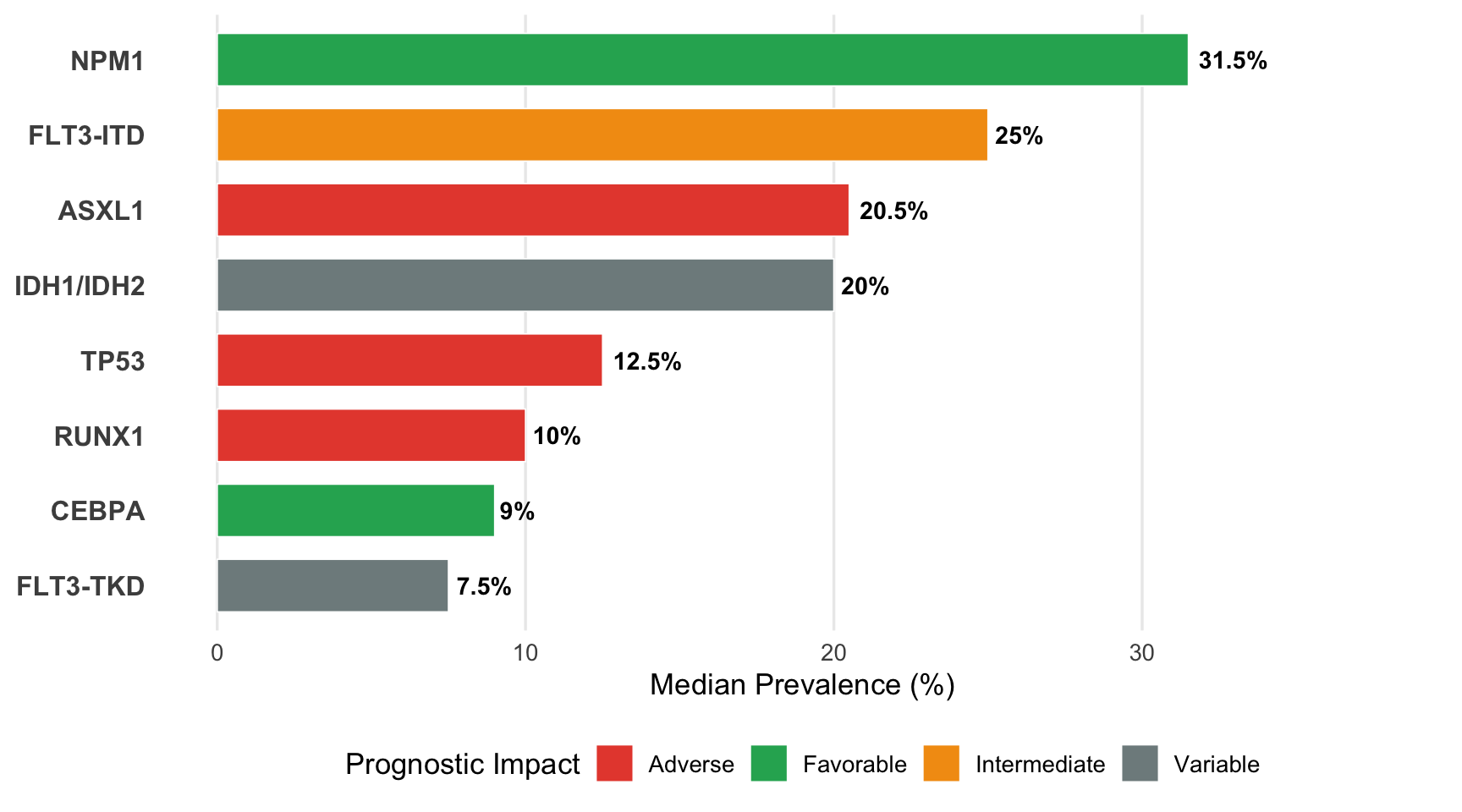
| NPM1 | 28–35% | Favorable | Favorable (if isolated) | Most common; cytoplasmic dislocation of nucleophosmin |
| FLT3-ITD | 20–30% | Intermediate*1 | Intermediate | Constitutive FLT3 kinase activation; VAF & ITD length modify prognosis |
| IDH1/IDH2 | ~20% | Variable | Favorable (IDH1/2 mutated) | Neomorphic enzymes producing 2-HG; targetable with ivosidenib/enasidenib |
| CEBPA | 7–11% | Favorable | Favorable (bZIP in-frame) | Biallelic bZIP mutations favorable; single mutations less clear |
| ASXL1 | 5–36% | Adverse | Adverse | Epigenetic regulator; enriched in older patients and secondary AML |
| RUNX1 | ~10% | Adverse | Adverse | Transcription factor; impaired differentiation |
| TP53 | 12–13% | Adverse | Adverse | Tumor suppressor; complex karyotype association; very poor prognosis |
| FLT3-TKD | 5–10% | Variable | — | D835 most common; less consistent prognostic impact than ITD |
| 1 *FLT3-ITD is classified as intermediate risk regardless of VAF in ELN 2022, a departure from ELN 2017 where high VAF without NPM1 co-mutation was adverse risk. | ||||
| ELN = European LeukemiaNet. Adapted from Döhner et al. Blood 2022 and Stancioaica et al. Cancers 2025. | ||||
3 FLT3 Mutated AML
Biology, Targeted Therapy, and Resistance Mechanisms
3.1 Epidemiology & Molecular Landscape
- Approximately 6,600 new AML cases harbor FLT3 mutations annually.
- FLT3 mutations are detected in roughly 30% of newly diagnosed AML, making FLT3 one of the most frequently mutated genes in the disease.
- Internal tandem duplications (ITDs) account for 20–25% of cases and are associated with a more aggressive clinical course, while tyrosine kinase domain (TKD) point mutations occur in 5–10% and carry a less consistent prognostic impact.
ImportantPCR vs. NGS for FLT3-ITD Detection
FLT3-ITD must be checked by fragment analysis (PCR). NGS will miss long ITDs (such as >120 bp), leading to false-negative results. This is a critical testing consideration at diagnosis.
3.1.1 AML Mutation Prevalence
3.1.2 Prevalence Visualization
3.1.3 Historical Outcome Data
- From a 2007 retrospective analysis of 1,107 adult AML patients from the United Kingdom (median age 42 years), 10-year OS in patients with FLT3-ITD was 24% (n = 257) compared to 51% for FLT3-TKD (n = 100); OR 0.53 (95% CI: 0.41–0.69; P < 0.001, log-rank test).
- This historical data underscores the significantly worse prognosis associated with ITD mutations compared to TKD mutations in the pre-FLT3 inhibitor era.
3.2 FLT3 Across Hematologic Malignancies
FLT3 mutations are not restricted to AML. Their frequency, mutation spectrum, and clinical significance vary across disease subtypes. The table below provides a comprehensive comparison across AML, APL, and ALL.
| FLT3 Mutations: Cross-Disease Comparison | ||||||
| AML, APL, and ALL — Frequency, Biology, and Therapeutic Implications | ||||||
| Disease | Frequency | Mutation Type(s) | Co-mutations | Clinical Features | Prognostic Impact | FLT3i Role |
|---|---|---|---|---|---|---|
| AML | ~30% | ITD (20–30%); TKD (5–10%) | NPM1, DNMT3A | Hyperleukocytosis, CNS involvement; VAF & ITD length modify risk; co-mutations shift prognosis | Intermediate (ELN 2022); co-mutations critical | Approved & standard of care (midostaurin, gilteritinib, quizartinib) |
| APL | 30–40% | ITD, TKD | — | DIC, microgranular variant; CD34+/HLA-DR+ atypical immunophenotype | Mitigated by ATRA + ATO; high VAF may still worsen outcome | No established role; anecdotal in relapse |
| ALL | 2–22%*1 | ITD, TKD, overexpression | MLLr, ZNF384r | Poor prognosis in MLL-AF4+; high relapse rates; overexpression adverse in certain subtypes | Adverse in MLLr; overexpression predicts treatment failure | Investigational; blasts sensitive to FLT3 inhibition |
| 1 *Higher in specific subgroups: 18% of MLLr, 28% of hyperdiploid B-ALL, up to 37.5% in ETP-ALL. | ||||||
| MLLr = MLL-rearranged; ZNF384r = ZNF384-rearranged; DIC = disseminated intravascular coagulation; ATRA = all-trans retinoic acid; ATO = arsenic trioxide. Adapted from Stancioaica et al. Cancers 2025, Table 1. | ||||||
3.3 FLT3 Signaling and Pathogenesis
FLT3 is a class III receptor tyrosine kinase first cloned in 1991. Upon ligand binding, the receptor dimerizes and autophosphorylates, activating three major downstream cascades:
| FLT3 Downstream Signaling in AML | |||
| Key Pathways Driving Leukemogenesis and Resistance | |||
| Pathway | Normal Function | In FLT3-Mutant AML | Therapeutic Implications |
|---|---|---|---|
| STAT5A | Differentiation and immune signaling | Constitutive activation drives antiapoptotic gene expression | Directly suppressed by FLT3 inhibitors; PIA assay measures STAT5 inhibition |
| PI3K/AKT | Cell survival and proliferation | Enhanced survival signaling independent of FLT3 ligand | Parallel pathway activation can bypass FLT3 inhibition |
| RAS/MAPK (via GRB2/SHP2) | Cell proliferation and survival | Sustains proliferative advantage; activation loop mutations drive resistance | RAS pathway mutations are the most common cause of FLT3i resistance |
| PIA = plasma inhibitory activity assay. Based on Stancioaica et al. Cancers 2025 and Kazi & Rönnstrand Physiol Rev 2019. | |||
NoteClass I vs. Class II Mutations in AML
Class I mutations (e.g., FLT3, RAS, KIT) promote proliferation and inhibit apoptosis through constitutive kinase activation. Class II mutations (e.g., NPM1, CEBPA, RUNX1) impair differentiation and enhance self-renewal. Cooperative interplay between these classes drives leukemogenesis.
3.4 Treatment of FLT3-Mutated AML
3.4.1 FLT3 Inhibitor Comparison
Three FLT3 inhibitors have received FDA approval, each with distinct pharmacologic profiles, binding characteristics, and clinical niches.
| FLT3 Inhibitors in AML: Head-to-Head Comparison | |||||||
| Approved and Investigational Agents — Pharmacology, Efficacy, and Safety | |||||||
| Agent | Type / Class | FLT3 Coverage | Off-Target | Pivotal Trial | Key Efficacy | Key Toxicities | FDA Status |
|---|---|---|---|---|---|---|---|
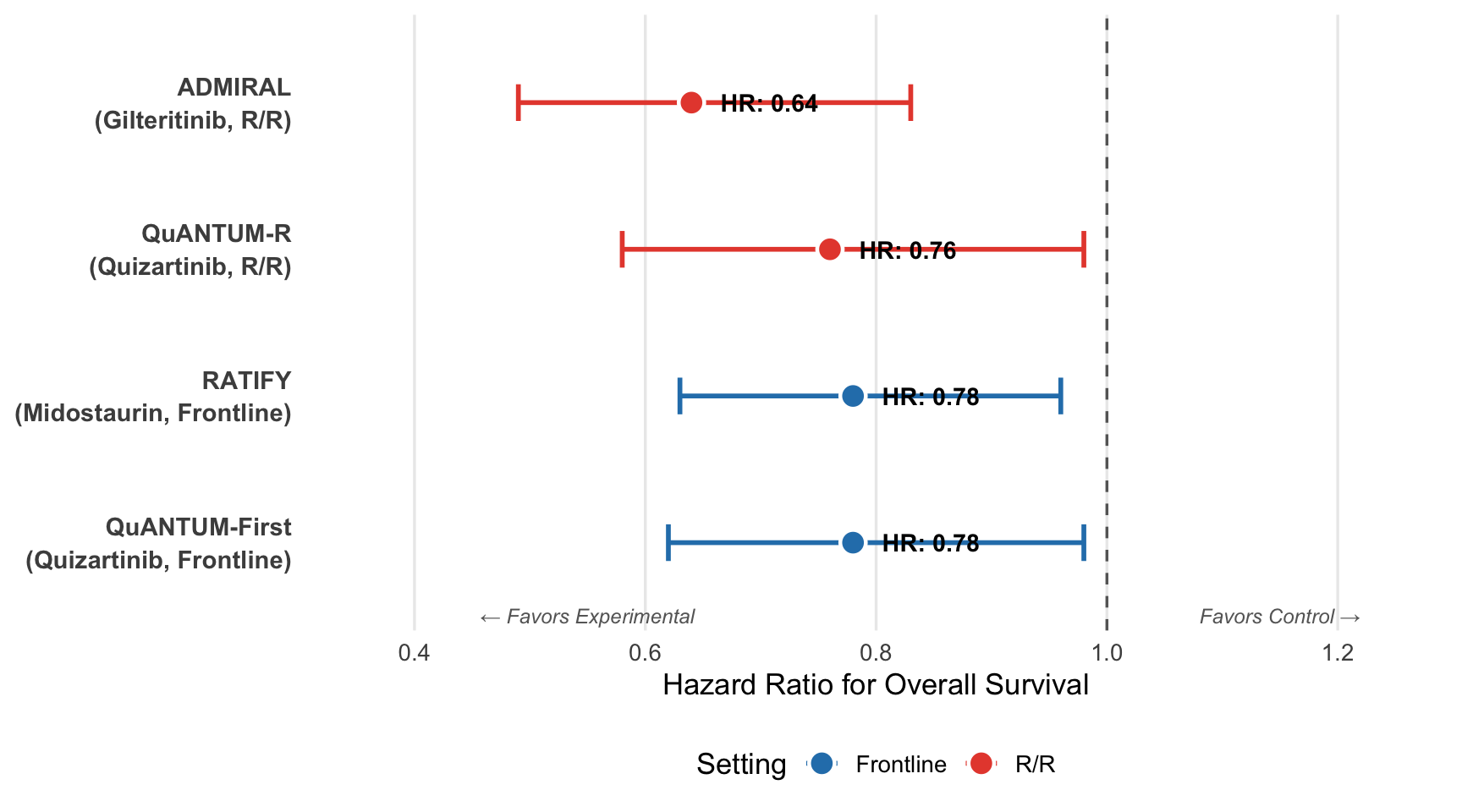
| Midostaurin | Type I (multikinase) | ITD + TKD | PKC, KIT, PDGFR, VEGFR | RATIFY | OS HR 0.78 (P = 0.009) frontline | Broad off-target effects; modest single-agent activity | Approved (2017): Frontline FLT3-mut + chemo |
| Gilteritinib | Type I (selective) | ITD + TKD (D835) | AXL, ALK, LTK | ADMIRAL | mOS 9.3 vs 5.6 mo; HR 0.64 in R/R | QTc prolongation; differentiation syndrome | Approved (2018): R/R FLT3-mutated AML |
| Quizartinib | Type II (selective) | ITD only*1 | c-KIT (moderate) | QuANTUM-First | mOS 31.9 vs 15.1 mo; HR 0.78 frontline | QTc prolongation; cytopenias (c-KIT inhibition) | Approved (2023): Frontline FLT3-ITD + chemo |
| Crenolanib | Type I (highly selective) | ITD + TKD (incl. D835, F691L) | Minimal (weak PDGFR/KIT) | Phase III (NCT03258931) | CR/CRc ~85% frontline (Phase II) | GI and hepatic toxicity | Not approved (Phase III ongoing) |
| Sorafenib | Type II (multikinase) | ITD (limited TKD) | RAF, VEGFR, PDGFR, KIT | SORAML / SORMAIN | RFS benefit; OS HR 0.90 frontline (NS) | Broad off-target toxicity; cytopenias; hand-foot syndrome | Not approved for AML |
| 1 *Quizartinib binds FLT3 in the inactive conformation and is therefore ineffective against D835 TKD mutations. TKD mutations can emerge as resistance mechanism under quizartinib therapy. | |||||||
| OS = overall survival; HR = hazard ratio; mOS = median OS; R/R = relapsed/refractory; NS = not significant. Adapted from Stancioaica et al. Cancers 2025, Table 2. | |||||||
3.4.2 Midostaurin (RATIFY Trial)
Midostaurin is a first-generation, multikinase type I FLT3 inhibitor initially developed as a PKC inhibitor. The pivotal RATIFY trial (CALGB 10603) randomized 717 patients with newly diagnosed FLT3-mutated AML (ages 18–59) to midostaurin or placebo added to 7+3 induction and HiDAC consolidation.
TipRATIFY Key Results
- OS HR: 0.78 (one-sided P = 0.009)
- EFS HR: 0.78 (one-sided P = 0.002)
- Benefit consistent across FLT3-ITD (high and low VAF) and FLT3-TKD subtypes
- Early CR rates were similar between arms — survival benefit driven by durability of remission
- No established maintenance data from dedicated maintenance trials
3.4.3 Quizartinib (QuANTUM-First Trial)
Quizartinib is a potent, selective type II FLT3 inhibitor that binds the inactive conformation of FLT3, inhibiting downstream signaling including phospho-STAT5 suppression.
| QuANTUM-First: Quizartinib + Standard Chemotherapy | |||
| Frontline FLT3-ITD AML — Phase III Randomized Trial (Erba et al. Lancet 2023) | |||
| Endpoint | Result | HR (95% CI) | Clinical Interpretation |
|---|---|---|---|
| Overall Survival (ITT) | 22% reduction in risk of death | 0.78 (0.62–0.98); P = 0.032 | Statistically significant OS benefit with quizartinib + chemotherapy |
| OS: Maintenance after consolidation (n = 89/208) | OS HR: 0.40 (95% CI: 0.19–0.84) | 0.40 (0.19–0.84)*1 | Striking benefit for non-transplant maintenance — potential for single-agent continuation |
| OS: Maintenance after HSCT (n = 119/208) | OS HR: 1.62 (95% CI: 0.62–4.22) | 1.62 (0.62–4.22)* | No benefit observed post-HSCT; possible interference with GVL effect |
| Patients not proceeding to transplant | ~60% of trial patients | — | Majority did not proceed to allo-HSCT; single-agent quizartinib maintenance an option |
| 1 *Exploratory subgroup analyses; not powered for definitive conclusions. | |||
| VANFLYTA (quizartinib) is contraindicated in patients with severe hypokalemia, severe hypomagnesemia, long QT syndrome, or history of ventricular arrhythmias/torsades de pointes. | |||
3.4.3.1 Decitabine plus venetoclax plus quizartinib (ASCO 2026)
ASCO 2026 Abstract #6504 (Oral) — MDACC + Moffitt — NCT03661307 phase I/II of quizartinib + decitabine + venetoclax triplet in FLT3-ITD AML (frontline-unfit n=42; R/R n=46; total n=88). RP2D quizartinib 26.5 mg/day.
Top 5 takeaways:
The FLT3 arm of the AML triplet paradigm — parallels the existing IDH triplet (HMA+VEN+IDHi)
Frontline (n=42, median age 70): CR 72% + CRi 17% = 89% CR/CRi; EOC1 MFC-MRD-neg 58%, best 68%; best FLT3-NGS-negativity 83% (deep molecular responses)
Frontline median OS 36.5 mo, RFS 24.7 mo — strikingly good for older FLT3-ITD AML (far exceeds VIALE-A FLT3-mut subgroup)
ASCT in CR1 did NOT improve OS (NR with vs 36.6 mo without; p=0.65 landmark) — provocative: the triplet alone may achieve durable remissions, questioning transplant in CR1 for older FLT3-ITD AML
R/R cohort (n=46) underwhelming: CR/CRi 28%, median OS 6.3 mo — the triplet’s value is concentrated frontline; count-recovery delays (~40 days to ANC>500) + infection burden notable
Strategic relevance: extends quizartinib beyond its fit-AML 7+3 QuANTUM-First role into the unfit/triplet setting; slots into the doublet-vs-triplet synthesis as the FLT3 sibling of the IDH triplet; MDACC triplet program (Daver/DiNardo). Quizartinib, decitabine, venetoclax, FLT3, and both triplet/FLT3 syntheses already in vault.
3.4.4 Gilteritinib (ADMIRAL Trial)
Gilteritinib is a second-generation, selective type I FLT3 inhibitor with activity against both ITD and TKD mutations (including D835). It also inhibits AXL, a kinase implicated in FLT3 inhibitor resistance.
| ADMIRAL Trial: Gilteritinib vs. Salvage Chemotherapy | |||
| R/R FLT3-Mutated AML — Phase III (Perl et al. NEJM 2019) | |||
| Outcome | Gilteritinib | Salvage Chemo | Effect |
|---|---|---|---|
| Median OS | 9.3 months | 5.6 months | HR 0.64 |
| CR/CRh rate | 34% | 15% | OR 2.9 |
| Bridge to allo-BMT | 63 patients | 19 patients | 3.3× higher |
| Patients alive on study at publication | 38 patients | 0 patients | ∞ (38 vs 0) |
| FLT3 TKI-naïve patients | Majority | — | — |
| Most patients were FLT3 TKI-naïve; real-world efficacy may differ in patients with prior FLT3 inhibitor exposure. | |||
3.4.5 Crenolanib: Next-Generation Type I FLT3 Inhibition
Crenolanib is a highly selective type I FLT3 inhibitor that maintains activity against both ITD and TKD mutations, including the resistance-associated D835 and gatekeeper F691L substitutions. Its minimal off-target kinase profile may offer advantages in tolerability and hematopoietic recovery.
The ongoing Phase III trial (NCT03258931) compares crenolanib + chemotherapy vs. midostaurin + chemotherapy in newly diagnosed FLT3-mutated AML.
3.4.6 Clinical Trial Efficacy Comparison
3.5 FLT3 Inhibitor Maintenance
No FLT3 inhibitor has received regulatory approval for maintenance therapy. However, several randomized trials have provided important insight.
| FLT3 Inhibitor Maintenance: Randomized Trial Evidence | |||||||
| Post-Transplant Maintenance in FLT3-ITD AML | |||||||
| Trial | Agent | N | Setting | Primary Endpoint | OS Benefit | Key Findings | Prior TKI |
|---|---|---|---|---|---|---|---|
| SORMAIN | Sorafenib | 83 | Post allo-BMT | 2y RFS: 85% vs 53% | 2y OS: 90% vs 66% | Robust benefit in TKI-naïve patients; increased chronic GVHD suggesting GVL augmentation | Naïve |
| Chinese Multicenter | Sorafenib | 202 | Post allo-BMT | Reduced relapse; improved OS | Yes | Confirmatory evidence for sorafenib post-transplant maintenance | Naïve |
| RADIUS | Midostaurin | 60 | Post allo-BMT | No significant RFS/OS difference | No | Possible under-dosing (PIA assay); small sample size; numerical relapse reduction | Naïve |
| MORPHO | Gilteritinib | 356 | Post allo-HCT | RFS: HR 0.68 (P = 0.0518) | Not met overall | MRD-positive patients: HR 0.56 (P = 0.02); MRD-negative patients: no benefit; RIC conditioning amplifies benefit | Mixed |
| RFS = relapse-free survival; RIC = reduced-intensity conditioning; GVL = graft-versus-leukemia; PIA = plasma inhibitory activity assay. Adapted from Stancioaica et al. Cancers 2025. | |||||||
ImportantMORPHO Trial: Precision Medicine Insight
The MORPHO trial demonstrated that MRD status is the critical determinant of gilteritinib maintenance benefit post-transplant. MRD-positive patients (pre- or post-HCT) derived significant benefit (HR 0.40–0.56), while MRD-negative patients did not. Patients receiving reduced-intensity conditioning showed the greatest benefit. This supports an MRD-directed approach to FLT3 inhibitor maintenance.
3.6 Mechanisms of Resistance to FLT3 Inhibitors
Resistance to FLT3 inhibitors is a major clinical challenge and can be broadly classified as cell-intrinsic (arising within leukemic cells) or cell-extrinsic (driven by the bone marrow microenvironment).
| Resistance Mechanisms to FLT3 Inhibitors | |||
| Cell-Intrinsic and Cell-Extrinsic Pathways with Emerging Therapeutic Strategies | |||
| Category | Mechanism | Description | Emerging Strategies |
|---|---|---|---|
| Cell-Intrinsic | TKD Mutations (D835, F691L) | D835 substitutions confer resistance to type II inhibitors (quizartinib, sorafenib). F691L gatekeeper mutations reduce binding affinity across all FLT3 inhibitor classes. | Type I inhibitors (gilteritinib, crenolanib); FLT3-directed CAR-T (AMG-553); covalent FLT3 inhibitors (FF-10101) |
| Cell-Intrinsic | RAS/MAPK Pathway Activation | Most common contributor to primary refractory disease and relapse. Activating NRAS/KRAS mutations sustain proliferation despite FLT3 inhibition. | Pan-RAS inhibitors (RMC-7977); dual FLT3 + MEK inhibition |
| Cell-Intrinsic | Epigenetic Regulators (IDH1/2) | IDH1/2 co-mutations associated with relative resistance to FLT3 inhibition. Phase I trials combining gilteritinib + IDH inhibitors are underway. | Gilteritinib + ivosidenib or enasidenib combinations |
| Cell-Intrinsic | Metabolic Reprogramming / BCL-2 Upregulation | FLT3-mutant blasts increase reliance on mitochondrial respiration and upregulate BCL-2, MCL-1, and BCL-XL under therapeutic pressure. | Venetoclax + FLT3 inhibitor combinations; triplet regimens (HMA + VEN + FLT3i) |
| Cell-Extrinsic | Cytokine Signaling (FLT3L, FGF2, CXCL12) | Marrow stromal cytokines activate alternative pro-survival pathways (RAS/MAPK, PI3K/AKT). Chemotherapy-induced FLT3L surges attenuate FLT3 TKI efficacy. | Covalent FLT3 inhibitors (FF-10101) that overcome FLT3L competition; avoid chemotherapy-induced FLT3L surges |
| Cell-Extrinsic | CYP3A4 Stromal Metabolism | Stromal CYP3A4 metabolizes FLT3 inhibitors locally, creating pharmacologic sanctuaries within the niche. Most novel AML drugs are CYP3A4 substrates. | Drug design to minimize CYP3A4 dependence; niche-disrupting strategies |
| Cell-Extrinsic | CYP26-Mediated Retinoid Degradation | Bone marrow CYP26 enzymes degrade retinoic acid, protecting blasts from differentiation. ATO downregulates CYP26B1 and re-sensitizes AML to FLT3i + retinoids. | ATO + gilteritinib combinations; synthetic retinoid-resistant analogs |
| ATO = arsenic trioxide; HMA = hypomethylating agent; VEN = venetoclax. Adapted from Stancioaica et al. Cancers 2025 and Ghiaur & Levis Hematol Oncol Clin N Am 2017. | |||
3.6.1 TKD Mutation Susceptibility by FLT3 Inhibitor
| FLT3 Inhibitor Activity Against Resistance-Conferring Mutations | |||||
| Type I vs. Type II vs. Covalent Inhibitor Coverage | |||||
| Agent | Type | D835 | F691L | N676K | Clinical Impact |
|---|---|---|---|---|---|
| Midostaurin | Type I | Active | Reduced | Variable | Broad activity but modest potency |
| Gilteritinib | Type I | Active | Substantially reduced | Variable | F691L = acquired resistance mechanism in clinical practice |
| Quizartinib | Type II | Resistant | Resistant | Variable | Classic resistance; drives TKD mutation emergence under therapy |
| Crenolanib | Type I | Active | Reduced (some activity) | Variable | Broadest spectrum but potency reduced at gatekeeper |
| FF-10101 | Covalent | Active | Active | Active | Irreversible binding overcomes ligand-mediated and mutation-mediated resistance |
| FF-10101 is a covalent (irreversible) FLT3 inhibitor currently in Phase I. Adapted from Stancioaica et al. Cancers 2025 and Kennedy & Smith Int J Hematol 2024. | |||||
3.7 Emerging Combination Strategies
3.7.1 FLT3 Inhibitors + Menin Inhibitors
FLT3 is a putative transcriptional target of MEIS1, whose expression depends on the menin–KMT2A interaction. Menin inhibition transcriptionally suppresses FLT3 expression, providing a strong rationale for combined FLT3 and menin inhibition in KMT2Ar, NPM1-mutated, or NUP98r leukemias with FLT3 co-mutation.
| Emerging Combination Strategies with FLT3 Inhibitors | |||
| Rationale, Clinical Development Stage, and Key Evidence | |||
| Combination | Rationale | Development Stage | Key Evidence |
|---|---|---|---|
| FLT3i + Venetoclax (± HMA) | BCL-2 upregulation under FLT3i pressure; preclinical synergy | Phase Ib/II (aza + VEN + gilteritinib; aza + VEN + quizartinib) | Impressive remission rates but high myelosuppression and infection risk; VEN duration optimization critical |
| FLT3i + Menin Inhibitor | Menin inhibition downregulates FLT3 transcription via MEIS1; synergy in KMT2Ar/NPM1mt | Phase I/II (revumenib + gilteritinib; revumenib + midostaurin) | BEAT-AML: 81.4% response rates with menin inhibitor combinations (project data). Multiple ongoing trials. |
| FLT3i + IDH Inhibitor | IDH1/2 co-mutations associated with FLT3i resistance | Phase I (gilteritinib + ivosidenib or enasidenib) | Ongoing enrollment; early tolerability data |
| FLT3i + ATO | ATO downregulates stromal CYP26B1, restoring retinoid signaling and FLT3i sensitivity | Preclinical (xenograft models showing prolonged treatment-free survival) | Gilteritinib + ATO prolonged treatment-free survival in xenografts; improved FLT3i sensitivity in stromal coculture |
| FLT3i + RAS Inhibitor | RAS/MAPK is the most common resistance pathway to FLT3 inhibition | Preclinical (RMC-7977 pan-RAS inhibitor) | Preclinical proof-of-concept for dual targeting |
| FLT3-directed CAR-T (AMG-553) | Bypasses kinase-domain-mediated resistance entirely | Early clinical development | Nonclinical safety established (Karbowski et al. *Toxicol Sci* 2020) |
| VEN = venetoclax; HMA = hypomethylating agent; ATO = arsenic trioxide. Data from Stancioaica et al. Cancers 2025, Issa et al. Blood Cancer Discov 2025, and project knowledge. | |||
3.8 Summary & Key Takeaways
| Clinical Decision Framework: FLT3-Mutated AML | |||
| Treatment Selection by Setting, Mutation Type, and Key Considerations | |||
| Clinical Setting | FLT3 Type | Preferred Agent(s) | Key Considerations |
|---|---|---|---|
| Newly Diagnosed (Intensive-eligible) | FLT3-ITD | Quizartinib + 7+3 (QuANTUM-First) OR Midostaurin + 7+3 (RATIFY) | Quizartinib only covers ITD; no TKD activity. Consider co-mutations (NPM1, DNMT3A). |
| Newly Diagnosed (Intensive-eligible) | FLT3-TKD | Midostaurin + 7+3 (RATIFY) | Midostaurin covers both ITD and TKD. Quizartinib not effective for TKD. |
| Relapsed/Refractory | FLT3 ITD or TKD | Gilteritinib (ADMIRAL) | Most ADMIRAL patients were TKI-naïve. Real-world efficacy may differ with prior TKI exposure. |
| Post-Transplant Maintenance | FLT3-ITD | Sorafenib (SORMAIN, in TKI-naïve); Gilteritinib (if MRD+, MORPHO) | MRD status is the critical determinant of maintenance benefit. No FLT3i approved for maintenance. |
| Non-Transplant Maintenance | FLT3-ITD | Quizartinib continuation (QuANTUM-First exploratory data) | Exploratory data: HR 0.40 for maintenance after consolidation (non-transplant). |
| Resistance/Relapse on FLT3i | Any FLT3 | Consider type I if resistant to type II; triplet regimens; clinical trials (menin inhibitors, CAR-T) | Check for D835, F691L mutations. RAS pathway mutations are the most common resistance mechanism. |
| This framework synthesizes data from Stancioaica et al. Cancers 2025, pivotal clinical trials, and ELN 2022 recommendations. | |||
NoteReferences
Primary source: Stancioaica M-C, Coriu D, Ghiaur G. FLT3: A 35-Year Voyage from Discovery to the Next Generation of Targeted Therapy in AML. Cancers 2025; 17: 3415. doi:10.3390/cancers17213415
Additional sources: Stone et al. NEJM 2017 (RATIFY); Perl et al. NEJM 2019 (ADMIRAL); Erba et al. Lancet 2023 (QuANTUM-First); Levis et al. JCO 2024 (MORPHO); Burchert et al. JCO 2020 (SORMAIN); Issa et al. Blood Cancer Discov 2025 (Menin Inhibitor Combinations).